Authority
Boundary, easement, utility, road, permit, and owner authorization.
Planned mowing, resprout control, touch-up mulching, monitoring, seeding coordination, and access maintenance after clearing.
Estimate clearing cost↗Checked 2026-09-01
Planned mowing, resprout control, touch-up mulching, monitoring, seeding coordination, and access maintenance after clearing. Rotary cutter on ground that has become mowable, mulching head on ground that has not yet, handling 1–3 inches — this scope exists to stop stems ever getting bigger than that again. A planning range of 1–4 acres per day, and falling every year the interval is kept covers most projects — maintenance production improves over time, which is the entire argument for it. The second visit is faster than the first and the fifth is faster than the second, because there is less each time. The best window is late summer, when the season's growth is fully expressed and cutting it costs the plant the most. It finishes resprouts and seedlings taken back before they become woody, but not any expansion of the cleared area — that is a new clearing scope — those are separate, separately-priced scopes.
A cleared property is not automatically a maintained property. Sunlight, disturbed growth, root systems, and seed banks can produce a strong response, especially where invasive or vigorous woody plants are present.
The closeout plan should identify likely regrowth, the first inspection date, what can be mowed, where hand or licensed treatment may be needed, and how the landowner wants the site to develop.
Best window: Late summer, when the season's growth is fully expressed and cutting it costs the plant the most.
Avoid: Very early spring, which removes little and gives the plant the whole season to recover.
| Factor | What it does to the job |
|---|---|
| Interval kept | Every year skipped raises the cost of the next visit disproportionately. |
| Invasive presence | Buckthorn and honeysuckle push toward annual; native regrowth is more forgiving. |
| Area held | Priced by the acre held, which is why the cleared area size is a long-term cost decision. |
| Terrain | Whether the ground has become tractor-mowable or still needs a tracked machine. |
| Monitoring | A walked and photographed record costs little and makes every later decision cheaper. |
| Included in this scope | Status |
|---|---|
| Resprouts and seedlings taken back before they become woody | Finished by this scope |
| The cleared area held at the size it was cleared to | Finished by this scope |
| Access and corridors kept passable | Finished by this scope |
| A record of what is coming back and where, which is what makes the next decision easy | Finished by this scope |
| Any expansion of the cleared area — that is a new clearing scope | NOT finished — price separately |
| Licensed herbicide treatment, which needs an applicator | NOT finished — price separately |
| Soil, seeding or planting work | NOT finished — price separately |
Photograph the cleared area from three fixed points on the day the work finishes. Repeat from the same three points every August. That series tells you more than any inspection.
The expensive mistake: Treating the first visit as the end of the project. The single biggest determinant of whether a clearing project was worth the money is whether anything happened in year two.
Doing it yourself: Absolutely, and this is the scope where landowner effort compounds most. Walking the same route each August, pulling seedlings and photographing the same three spots turns a recurring contractor visit into an occasional one.
Afterwards: This is the follow-up, and the interval is the whole product. Annual on aggressive ground, every two to three years on ground that is genuinely stabilising. Skipping two intervals usually costs more than the intervals would have.
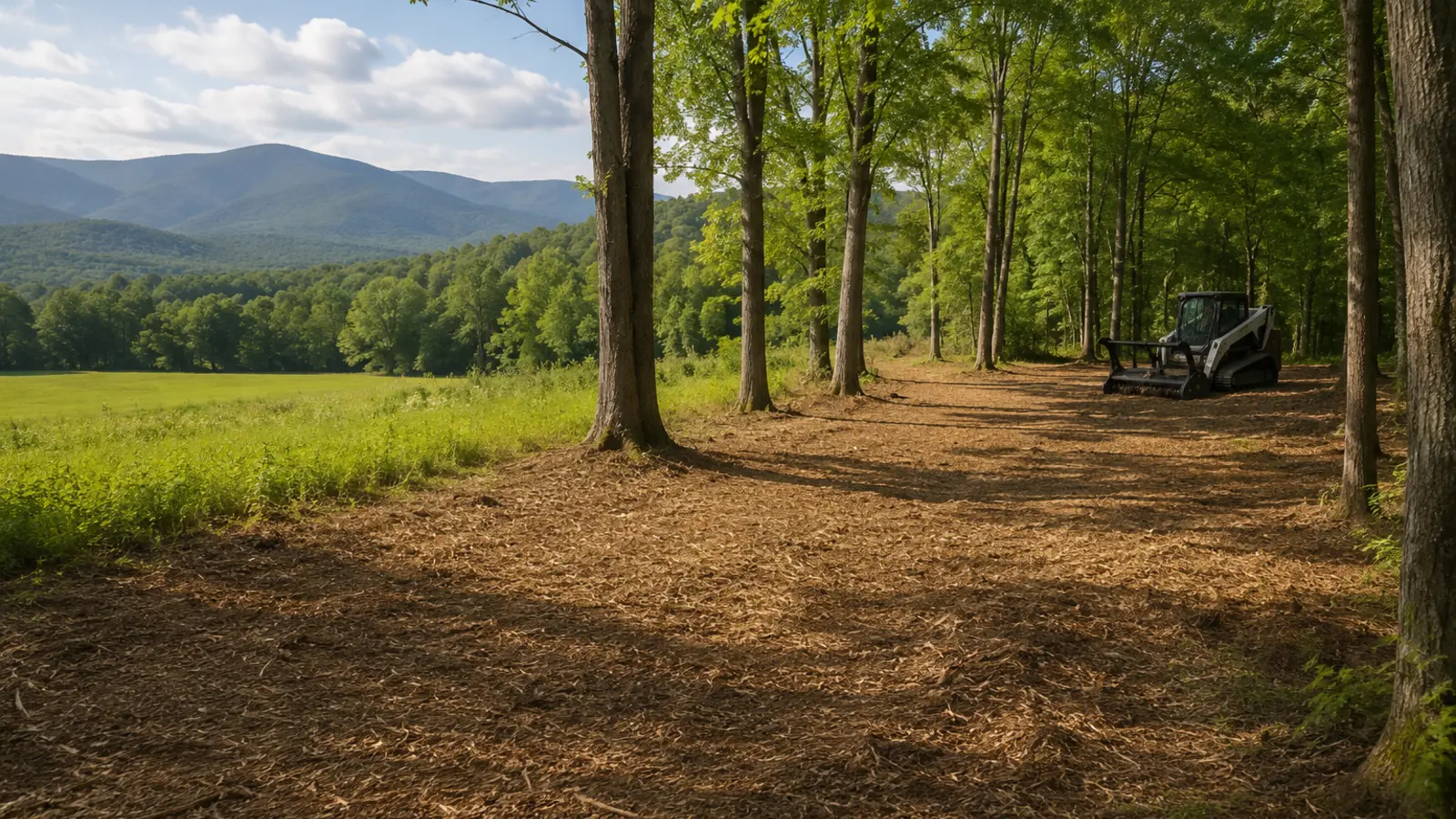
Identify species, likely resprouting, seed sources, mowable areas, inspection dates, restoration goals, and where a qualified applicator or land manager may be needed.
Initial clearing can restore access and reduce biomass. It does not promise eradication, stable pasture, or a permanent low-maintenance finish.
For post-clearing maintenance, write what stays, what goes, how material is handled, where machines may travel, and what the land should support next.
Boundary, easement, utility, road, permit, and owner authorization.
Vegetation, stem size, rock, wetness, debris, grade, and stable access.
Mulch, mow, cut, chip, fell, excavate, haul, or use a sequenced mix.
Finish tolerance, material location, restoration, inspection, and maintenance.
The questions below have no single published answer, so each names the office to ask rather than a figure to trust. Nothing here is a determination for your parcel — the authority named is the one whose answer counts.
Municipal bylaws vary town by town and are not published in any single state index. Overlay districts, ridgeline and steep-slope provisions, conservation districts, road-frontage and driveway-access standards, and tree ordinances all live at town level.
Ask: Call the zoning administrator for the town, give the parcel ID, and describe the actual activity — "removing 2 acres of woody vegetation with a mulching machine and building a 12-foot access track" gets a different answer than "brush clearing".
The town zoning administrator or town clerk · checked 2026-09-01
Clearing across a boundary is a trespass and in all three states timber trespass carries multiplied damages. Old wire, stone walls and hedgerows are evidence of a line, not proof of one, and brush hides all three.
Ask: Have the owner mark the limit of work on the ground before the crew arrives, and get a licensed surveyor where the line is uncertain, disputed, or within the width of the machine.
A Vermont, New York or New Hampshire licensed land surveyor · checked 2026-09-01
Rotary cutter on ground that has become mowable, mulching head on ground that has not yet. Planned mowing, resprout control, touch-up mulching, monitoring, seeding coordination, and access maintenance after clearing. On a post-Clearing Maintenance job the scope should name the marked work limit, the retained vegetation, how material is handled, and the finish standard — those four decide the price far more than the acreage does.
1–3 inches — this scope exists to stop stems ever getting bigger than that again. That number is the single most useful thing to establish before anyone quotes post-Clearing Maintenance, because it decides which machine comes and how many passes the work takes.
A planning range of 1–4 acres per day, and falling every year the interval is kept. Maintenance production improves over time, which is the entire argument for it. The second visit is faster than the first and the fifth is faster than the second, because there is less each time. This is a production screen, not a quote or a commitment to a schedule.
Rotary cutter on ground that has become mowable, mulching head on ground that has not yet. Machine choice on a post-Clearing Maintenance job follows the access route and the ground condition as much as the vegetation — a carrier that suits the work is no use if it cannot reach it.
Resprouts and seedlings taken back before they become woody; The cleared area held at the size it was cleared to; Access and corridors kept passable; A record of what is coming back and where, which is what makes the next decision easy. Anything beyond that list on a post-Clearing Maintenance project belongs in a separate, separately-priced scope.
Any expansion of the cleared area — that is a new clearing scope; Licensed herbicide treatment, which needs an applicator; Soil, seeding or planting work. Every one of those is a real and common expectation, which is why post-Clearing Maintenance proposals should state them as exclusions rather than leaving them to be discovered at turnover.
Late summer, when the season's growth is fully expressed and cutting it costs the plant the most.
Very early spring, which removes little and gives the plant the whole season to recover.
This is the follow-up, and the interval is the whole product. Annual on aggressive ground, every two to three years on ground that is genuinely stabilising. Skipping two intervals usually costs more than the intervals would have.
Interval kept — every year skipped raises the cost of the next visit disproportionately. Invasive presence — buckthorn and honeysuckle push toward annual; native regrowth is more forgiving. Area held — priced by the acre held, which is why the cleared area size is a long-term cost decision. Terrain — whether the ground has become tractor-mowable or still needs a tracked machine. Monitoring — a walked and photographed record costs little and makes every later decision cheaper.
Treating the first visit as the end of the project. The single biggest determinant of whether a clearing project was worth the money is whether anything happened in year two.
Absolutely, and this is the scope where landowner effort compounds most. Walking the same route each August, pulling seedlings and photographing the same three spots turns a recurring contractor visit into an occasional one.
Photograph the cleared area from three fixed points on the day the work finishes. Repeat from the same three points every August. That series tells you more than any inspection.
No. A planning range for post-Clearing Maintenance is arithmetic on the numbers you entered — it has not seen the access route, the boundary, the wet ground, the rock, or the largest stem. Production alone spans 1–4 acres per day, and falling every year the interval is kept before anything else is considered, which is why a site review comes before a price.
Municipal bylaws vary town by town and are not published in any single state index. Overlay districts, ridgeline and steep-slope provisions, conservation districts, road-frontage and driveway-access standards, and tree ordinances all live at town level. Call the zoning administrator for the town, give the parcel ID, and describe the actual activity — "removing 2 acres of woody vegetation with a mulching machine and building a 12-foot access track" gets a different answer than "brush clearing". On a post-Clearing Maintenance job specifically this comes before scheduling, not during: the machine handles 1–3 inches — this scope exists to stop stems ever getting bigger than that again, and it cannot tell the difference between what it is meant to cut and what it is not.
Clearing across a boundary is a trespass and in all three states timber trespass carries multiplied damages. Old wire, stone walls and hedgerows are evidence of a line, not proof of one, and brush hides all three. Have the owner mark the limit of work on the ground before the crew arrives, and get a licensed surveyor where the line is uncertain, disputed, or within the width of the machine. On a post-Clearing Maintenance job specifically this comes before scheduling, not during: the machine handles 1–3 inches — this scope exists to stop stems ever getting bigger than that again, and it cannot tell the difference between what it is meant to cut and what it is not.
Share the location, acreage, density, slope, access, photos, and intended outcome. We’ll turn the idea into a scope that can be evaluated on the property.
Request a site assessment↗Open the cost calculator →