Authority
Boundary, easement, utility, road, permit, and owner authorization.
Remove dense brush, briars, vines, saplings, and volunteer growth from yards, fields, edges, and unmanaged acreage.
Estimate clearing cost↗Checked 2026-09-01
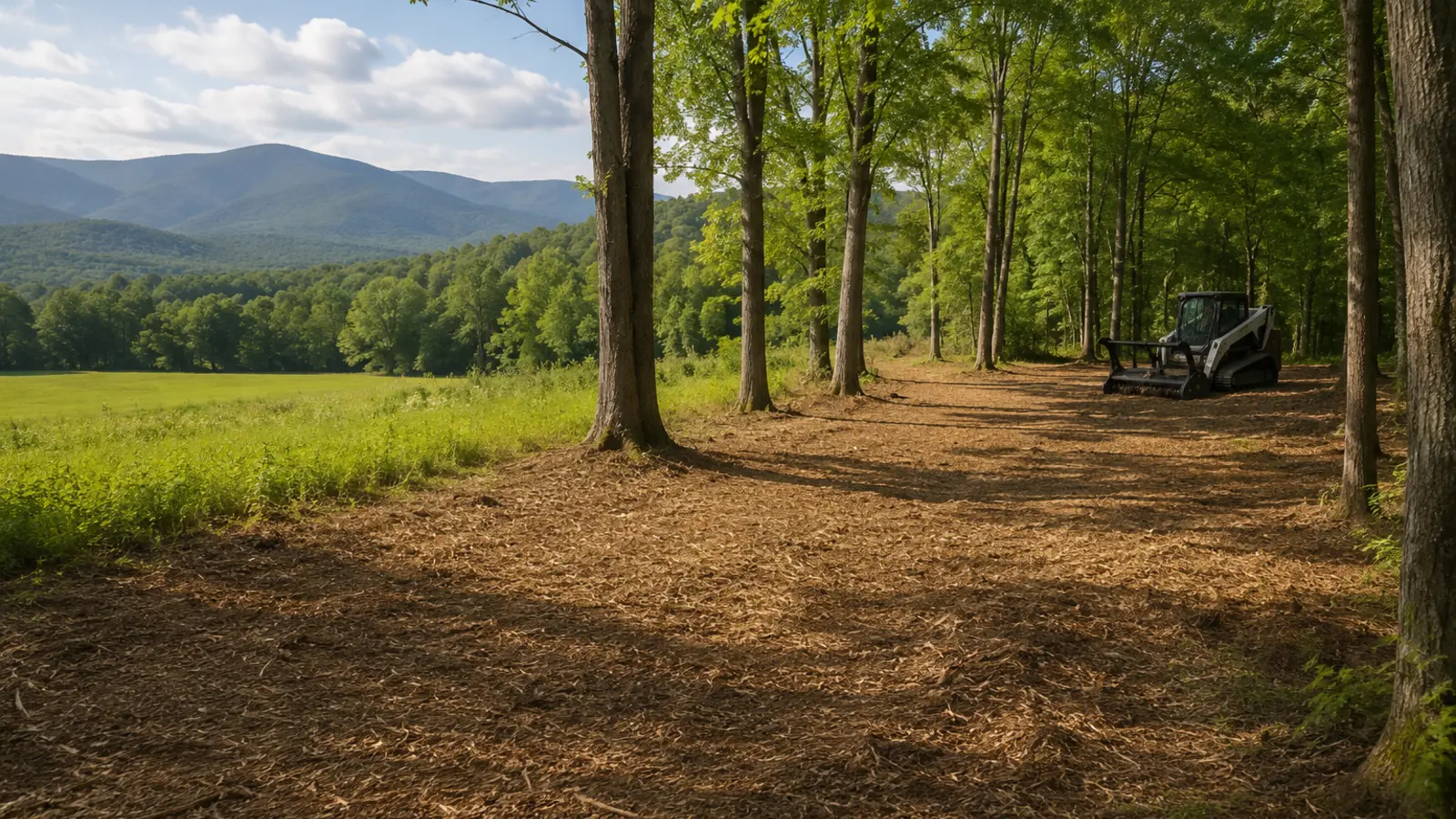
Remove dense brush, briars, vines, saplings, and volunteer growth from yards, fields, edges, and unmanaged acreage. A skid steer with a brush cutter or mulching head, dropping to hand work where the area is tight or selective, handling 2–4 inches typically; heavier stems push the job toward mulching or felling. A planning range of 0.5–2 acres per day covers most projects — brush clears faster than woody stands but slower than anyone expects when briars and vines are involved — multiflora rose and grape tangle into a mat that has to be worked apart rather than driven through. The best window is late autumn through winter. Briars and vines are far easier to see and cut without leaves, and hard ground keeps the machine out of soft spots the brush was hiding. It finishes dense brush, briars, vines and volunteer growth reduced to ground level, but not the root systems and seed bank that produced the brush — those are separate, separately-priced scopes.
Brush clearing can be selective or broad. The scope should identify what stays, what is cut, whether material is mulched or removed, the maximum stem size, the target ground finish, and any sensitive areas to avoid.
A clean result also considers the next season. Root systems, seed banks, and invasive species can resprout, so mowing, targeted follow-up, planting, or approved treatment may be part of a longer management plan.
Best window: Late autumn through winter. Briars and vines are far easier to see and cut without leaves, and hard ground keeps the machine out of soft spots the brush was hiding.
Avoid: Peak summer on unfamiliar ground — a full leaf canopy hides the hazards that hurt a machine, and dense green material packs a head rather than shredding.
| Factor | What it does to the job |
|---|---|
| Briar and vine content | Thorny tangle is the slowest material per square foot on most residential jobs. |
| What is buried in it | Old fence, dumped metal and stone are found by the machine if nobody finds them first. |
| Selectivity | Clearing to a marked line beside a lawn is slower than clearing an open block. |
| Ground condition | Wet or hummocky ground under brush forces a lighter, slower pass. |
| Disposal | Mulching in place costs nothing extra; hauling the material away is a separate line. |
| Included in this scope | Status |
|---|---|
| Dense brush, briars, vines and volunteer growth reduced to ground level | Finished by this scope |
| The actual shape and grade of the ground made visible again | Finished by this scope |
| Field and yard edges pushed back to a defined line | Finished by this scope |
| Enough visibility to survey, inspect, or decide what to do next | Finished by this scope |
| The root systems and seed bank that produced the brush | NOT finished — price separately |
| Anything the brush was hiding — holes, wire, stone, dumping still need dealing with | NOT finished — price separately |
| A mowable surface, until the residue and any remaining stubs are dealt with | NOT finished — price separately |
Walk the perimeter and stake the exact line you want to keep, before anyone quotes. The difference between "clear the back" and a staked line is usually a third of the price either way.
The expensive mistake: Clearing right up to a boundary that nobody has actually located. Brush is exactly where old lines get lost, and cutting a neighbour's trees is the one mistake on this list with multiplied statutory damages attached to it in all three states.
Doing it yourself: This is the most DIY-able scope here, up to a point. A walk-behind brush mower handles an acre of light material over a few weekends. It stops being sensible when the stems are woody, the ground is unknown, or the area is big enough that the weekends run out before the growth does.
Afterwards: Brush cleared once and left alone is brush again in two to four seasons. The decision point is what the ground becomes: mowed a few times a year, planted, mulched again, or allowed to grow back deliberately as screening.

Record compatible maximum stem size, retained trees, remaining material, mulch distribution, visible stump expectation, and the access route.
Mulching processes vegetation in place. Grubbing, grading, imported soil, drainage construction, and a lawn-ready seedbed are different scopes.
For brush & underbrush clearing, write what stays, what goes, how material is handled, where machines may travel, and what the land should support next.
Boundary, easement, utility, road, permit, and owner authorization.
Vegetation, stem size, rock, wetness, debris, grade, and stable access.
Mulch, mow, cut, chip, fell, excavate, haul, or use a sequenced mix.
Finish tolerance, material location, restoration, inspection, and maintenance.
The 2 rules below were read from the agency or the statute on the date shown against each one. Nothing here is a determination for your parcel — the authority named is the one whose answer counts.
50 ft — Vermont, Wetlands
A 50-foot buffer zone runs contiguous to the boundary of every Class II wetland, and most mapped wetlands in Vermont are Class II. Removing vegetation, filling, dredging, ditching, draining or grading inside the wetland or that buffer needs a Vermont Wetland Permit unless it is an Allowed Use under Section 6 of the rules.
Clearing vegetation is explicitly named in the regulated activities, so a mulching pass into a buffer is a permit question even though nothing is being built.
Vermont Wetland Rules; 10 V.S.A. Chapter 37 · Vermont DEC Wetlands Program · checked 2026-09-01 · source
250 ft — Vermont, Shorelands
The Act regulates land within 250 feet of the mean water level of any lake larger than 10 acres. Creating "cleared area" — removing trees, shrubs or disturbing natural ground cover — needs a permit or a registration, the same as creating impervious surface.
Standards inside the protected shoreland: the site must be on a slope under 20%, no more than 20% of the parcel inside the area may be impervious, and no more than 40% may be cleared area. Registration B covers up to 500 sq ft of new cleared area or impervious surface between 100 and 250 feet from mean water level, if those three standards are met.
10 V.S.A. Chapter 49A, effective 1 July 2014 · Vermont DEC Lakes and Ponds Program · checked 2026-09-01 · source
A skid steer with a brush cutter or mulching head, dropping to hand work where the area is tight or selective. Remove dense brush, briars, vines, saplings, and volunteer growth from yards, fields, edges, and unmanaged acreage. On a brush & Underbrush Clearing job the scope should name the marked work limit, the retained vegetation, how material is handled, and the finish standard — those four decide the price far more than the acreage does.
2–4 inches typically; heavier stems push the job toward mulching or felling. That number is the single most useful thing to establish before anyone quotes brush & Underbrush Clearing, because it decides which machine comes and how many passes the work takes.
A planning range of 0.5–2 acres per day. Brush clears faster than woody stands but slower than anyone expects when briars and vines are involved — multiflora rose and grape tangle into a mat that has to be worked apart rather than driven through. This is a production screen, not a quote or a commitment to a schedule.
A skid steer with a brush cutter or mulching head, dropping to hand work where the area is tight or selective. Machine choice on a brush & Underbrush Clearing job follows the access route and the ground condition as much as the vegetation — a carrier that suits the work is no use if it cannot reach it.
Dense brush, briars, vines and volunteer growth reduced to ground level; The actual shape and grade of the ground made visible again; Field and yard edges pushed back to a defined line; Enough visibility to survey, inspect, or decide what to do next. Anything beyond that list on a brush & Underbrush Clearing project belongs in a separate, separately-priced scope.
The root systems and seed bank that produced the brush; Anything the brush was hiding — holes, wire, stone, dumping still need dealing with; A mowable surface, until the residue and any remaining stubs are dealt with. Every one of those is a real and common expectation, which is why brush & Underbrush Clearing proposals should state them as exclusions rather than leaving them to be discovered at turnover.
Late autumn through winter. Briars and vines are far easier to see and cut without leaves, and hard ground keeps the machine out of soft spots the brush was hiding.
Peak summer on unfamiliar ground — a full leaf canopy hides the hazards that hurt a machine, and dense green material packs a head rather than shredding.
Brush cleared once and left alone is brush again in two to four seasons. The decision point is what the ground becomes: mowed a few times a year, planted, mulched again, or allowed to grow back deliberately as screening.
Briar and vine content — thorny tangle is the slowest material per square foot on most residential jobs. What is buried in it — old fence, dumped metal and stone are found by the machine if nobody finds them first. Selectivity — clearing to a marked line beside a lawn is slower than clearing an open block. Ground condition — wet or hummocky ground under brush forces a lighter, slower pass. Disposal — mulching in place costs nothing extra; hauling the material away is a separate line.
Clearing right up to a boundary that nobody has actually located. Brush is exactly where old lines get lost, and cutting a neighbour's trees is the one mistake on this list with multiplied statutory damages attached to it in all three states.
This is the most DIY-able scope here, up to a point. A walk-behind brush mower handles an acre of light material over a few weekends. It stops being sensible when the stems are woody, the ground is unknown, or the area is big enough that the weekends run out before the growth does.
Walk the perimeter and stake the exact line you want to keep, before anyone quotes. The difference between "clear the back" and a staked line is usually a third of the price either way.
No. A planning range for brush & Underbrush Clearing is arithmetic on the numbers you entered — it has not seen the access route, the boundary, the wet ground, the rock, or the largest stem. Production alone spans 0.5–2 acres per day before anything else is considered, which is why a site review comes before a price.
It can, and on a brush & Underbrush Clearing job it is settled before the machine is scheduled — walk the perimeter and stake the exact line you want to keep, before anyone quotes. The difference between "clear the back" and a staked line is usually a third of the price either way. Class II wetlands carry a 50-foot buffer zone (Vermont Wetland Rules; 10 V.S.A. Chapter 37). Clearing vegetation is explicitly named in the regulated activities, so a mulching pass into a buffer is a permit question even though nothing is being built. Checked against Vermont DEC Wetlands Program on 2026-09-01. Because brush & Underbrush Clearing typically covers 0.5–2 acres per day, a stop part-way through for an approval that was never applied for costs more than the approval would have. The property owner is the applicant; a contractor's estimate is not a determination.
It can, and on a brush & Underbrush Clearing job it is settled before the machine is scheduled — walk the perimeter and stake the exact line you want to keep, before anyone quotes. The difference between "clear the back" and a staked line is usually a third of the price either way. Shoreland Protection Act reaches 250 feet from mean water level (10 V.S.A. Chapter 49A, effective 1 July 2014). Standards inside the protected shoreland: the site must be on a slope under 20%, no more than 20% of the parcel inside the area may be impervious, and no more than 40% may be cleared area. Registration B covers up to 500 sq ft of new cleared area or impervious surface between 100 and 250 feet from mean water level, if those three standards are met. Checked against Vermont DEC Lakes and Ponds Program on 2026-09-01. Because brush & Underbrush Clearing typically covers 0.5–2 acres per day, a stop part-way through for an approval that was never applied for costs more than the approval would have. The property owner is the applicant; a contractor's estimate is not a determination.
Share the location, acreage, density, slope, access, photos, and intended outcome. We’ll turn the idea into a scope that can be evaluated on the property.
Request a site assessment↗Open the cost calculator →