Request a site assessment
Land capability

Invasive Growth Removal

Mechanical clearing and long-term planning for buckthorn, honeysuckle, barberry, multiflora rose, knotweed, phragmites, and other aggressive growth.

Estimate clearing cost
Direct answer

How do I get rid of buckthorn, honeysuckle or knotweed on my land?

Checked 2026-09-01

Mechanical clearing and long-term planning for buckthorn, honeysuckle, barberry, multiflora rose, knotweed, phragmites, and other aggressive growth. Mulching head for the biomass, hand tools for the selective work, and a licensed applicator where treatment is part of the plan, handling 4–6 inches; buckthorn and honeysuckle rarely exceed that, knotweed never does. A planning range of 0.3–1 acre per day, plus every follow-up visit the species requires covers most projects — the first pass on an invasive stand is fast because the material is uniform. The reason the number looks low is that the honest scope includes the return visits, and a single-visit price for an invasive stand is a price for the wrong job. The best window is depends entirely on species, which is why identification comes before scheduling. Buckthorn and honeysuckle leaf out earlier and hold leaves later than most natives, so late autumn is the easiest time to see exactly what you have. It finishes the standing biomass reduced and access restored to ground that was impassable, but not eradication. One mechanical visit does not remove a species from a property. — those are separate, separately-priced scopes.

In practice

Control the plant, not only the visible top.

Different invasive plants respond differently to cutting. Some resprout vigorously, spread by fragments, or require carefully timed follow-up. Mechanical work should be paired with species identification and a realistic aftercare plan.

The site does not promise eradication from a single visit. It frames the work as suppression and land management, with referrals to qualified applicators or conservation resources when herbicide, disposal, or regulated-area decisions are involved.

Best window: Depends entirely on species, which is why identification comes before scheduling. Buckthorn and honeysuckle leaf out earlier and hold leaves later than most natives, so late autumn is the easiest time to see exactly what you have.

Avoid: Any timing chosen before the species is confirmed. With knotweed specifically, the wrong pass at the wrong time spreads the infestation instead of reducing it.

What drives the cost of invasive growth removal
FactorWhat it does to the job
SpeciesKnotweed is a different and more expensive job than buckthorn because of how it spreads.
Proximity to waterA stand near a stream or wetland brings buffer rules and fragment-transport risk into the plan.
Stand densityA closed buckthorn understory is uniform and fast; scattered stems across ten acres is not.
Follow-up commitmentA one-visit budget and a multi-season plan produce very different totals and very different results.
RestorationReplanting to hold the ground against reinvasion is a separate cost and often the one that decides the outcome.
Invasive Growth Removal: what it finishes and what it does not
Included in this scopeStatus
The standing biomass reduced and access restored to ground that was impassableFinished by this scope
The extent of the stand made visible and mappable for the first timeFinished by this scope
Desirable retained vegetation released from competitionFinished by this scope
A dated schedule for the follow-up the species actually needsFinished by this scope
Eradication. One mechanical visit does not remove a species from a property.NOT finished — price separately
The seed bank, which for buckthorn stays viable in the soil for yearsNOT finished — price separately
The root systems, which for most woody invasives resprout vigorously after cuttingNOT finished — price separately
Before you call

The one thing worth measuring first

Before cutting anything, photograph leaves, bark, branching pattern and the whole stand, and mark where the nearest water is. Identification decides the entire plan and cannot be done from a wide shot of green.
The expensive mistake: Mowing or moving soil through a knotweed stand before identifying it. Knotweed spreads from fragments, so ordinary machine work turns one patch into a line of patches along the route the machine took, and contaminated soil moved off site takes the problem with it.

Doing it yourself: Cutting is easy and mostly pointless on its own for the woody invasives — they resprout harder. Where a landowner genuinely adds value is monitoring: walking the same route each summer, photographing the same spots, and catching new seedlings while they are still pullable.

Afterwards: This is the scope where follow-up is the project rather than an afterthought. Expect a multi-season programme: initial reduction, a resprout assessment the following summer, then whatever combination of repeat cutting, mowing, licensed treatment and replanting the species and the landowner's goal call for.

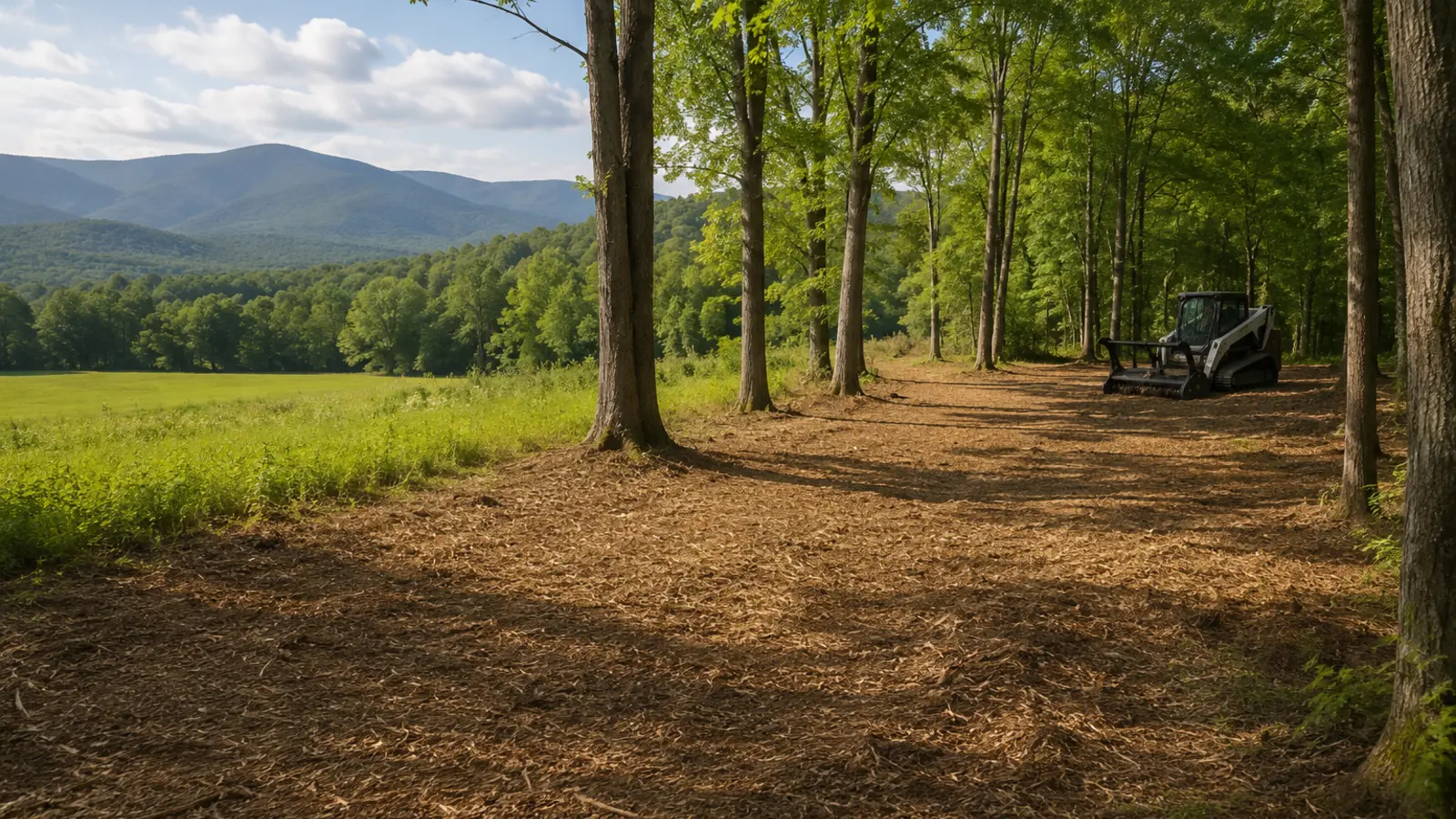
Selective vegetation clearing with retained trees and processed material
Illustrative finish, not a project claim. Actual results follow the marked work limit, vegetation, terrain, soil, access, and written turnover standard.
Field decision

Plan the second season with the first pass

Identify species, likely resprouting, seed sources, mowable areas, inspection dates, restoration goals, and where a qualified applicator or land manager may be needed.

Initial clearing can restore access and reduce biomass. It does not promise eradication, stable pasture, or a permanent low-maintenance finish.

For invasive growth removal, write what stays, what goes, how material is handled, where machines may travel, and what the land should support next.
A four-part project screen
01

Authority

Boundary, easement, utility, road, permit, and owner authorization.

02

Ground

Vegetation, stem size, rock, wetness, debris, grade, and stable access.

03

Method

Mulch, mow, cut, chip, fell, excavate, haul, or use a sequenced mix.

04

Closeout

Finish tolerance, material location, restoration, inspection, and maintenance.

Quote boundaries

Keep adjacent trades out of the gray area.

Define in this scopeDense invasive understoriesField-edge encroachmentAccess and visibility restorationMulti-season control programs
Price or verify separatelyTechnical tree work and riggingStump or root excavationGrading, drainage, and soilPermits, traffic control, treatment, or restoration
Verified against the primary source

What the rules say about invasive growth removal

The 2 rules below were read from the agency or the statute on the date shown against each one. Nothing here is a determination for your parcel — the authority named is the one whose answer counts.

Class II wetlands carry a 50-foot buffer zone

50 ft — Vermont, Wetlands

A 50-foot buffer zone runs contiguous to the boundary of every Class II wetland, and most mapped wetlands in Vermont are Class II. Removing vegetation, filling, dredging, ditching, draining or grading inside the wetland or that buffer needs a Vermont Wetland Permit unless it is an Allowed Use under Section 6 of the rules.

Clearing vegetation is explicitly named in the regulated activities, so a mulching pass into a buffer is a permit question even though nothing is being built.

Vermont Wetland Rules; 10 V.S.A. Chapter 37 · Vermont DEC Wetlands Program · checked 2026-09-01 · source

A 100-foot adjacent area is regulated alongside the wetland itself

100 ft — New York, Wetlands

A Freshwater Wetlands Permit is required to drain, dredge, excavate, fill, pollute or erect structures in a regulated wetland or within the 100-foot adjacent area around it. DEC currently regulates freshwater wetlands over 12.4 acres (5 hectares).

The size threshold drops to 7.4 acres on 1 January 2028, which will bring wetlands that are outside jurisdiction today inside it. DEC also states that its maps are a screening tool, not a final determination — a mapped absence is not permission.

Article 24, Environmental Conservation Law (Freshwater Wetlands Act) · New York State DEC · checked 2026-09-01 · source

Field questions

Know what the machine can—and cannot—solve.

01What does invasive Growth Removal actually involve?

Mulching head for the biomass, hand tools for the selective work, and a licensed applicator where treatment is part of the plan. Mechanical clearing and long-term planning for buckthorn, honeysuckle, barberry, multiflora rose, knotweed, phragmites, and other aggressive growth. On a invasive Growth Removal job the scope should name the marked work limit, the retained vegetation, how material is handled, and the finish standard — those four decide the price far more than the acreage does.

02What is the largest stem invasive Growth Removal can handle?

4–6 inches; buckthorn and honeysuckle rarely exceed that, knotweed never does. That number is the single most useful thing to establish before anyone quotes invasive Growth Removal, because it decides which machine comes and how many passes the work takes.

03How much ground can invasive Growth Removal cover in a day?

A planning range of 0.3–1 acre per day, plus every follow-up visit the species requires. The first pass on an invasive stand is fast because the material is uniform. The reason the number looks low is that the honest scope includes the return visits, and a single-visit price for an invasive stand is a price for the wrong job. This is a production screen, not a quote or a commitment to a schedule.

04What equipment is used for invasive Growth Removal?

Mulching head for the biomass, hand tools for the selective work, and a licensed applicator where treatment is part of the plan. Machine choice on a invasive Growth Removal job follows the access route and the ground condition as much as the vegetation — a carrier that suits the work is no use if it cannot reach it.

05What does invasive Growth Removal actually finish?

The standing biomass reduced and access restored to ground that was impassable; The extent of the stand made visible and mappable for the first time; Desirable retained vegetation released from competition; A dated schedule for the follow-up the species actually needs. Anything beyond that list on a invasive Growth Removal project belongs in a separate, separately-priced scope.

06What does invasive Growth Removal not finish?

Eradication. One mechanical visit does not remove a species from a property.; The seed bank, which for buckthorn stays viable in the soil for years; The root systems, which for most woody invasives resprout vigorously after cutting. Every one of those is a real and common expectation, which is why invasive Growth Removal proposals should state them as exclusions rather than leaving them to be discovered at turnover.

07When is the best time of year for invasive Growth Removal?

Depends entirely on species, which is why identification comes before scheduling. Buckthorn and honeysuckle leaf out earlier and hold leaves later than most natives, so late autumn is the easiest time to see exactly what you have.

08When should invasive Growth Removal be avoided?

Any timing chosen before the species is confirmed. With knotweed specifically, the wrong pass at the wrong time spreads the infestation instead of reducing it.

09What happens on the property after invasive Growth Removal is done?

This is the scope where follow-up is the project rather than an afterthought. Expect a multi-season programme: initial reduction, a resprout assessment the following summer, then whatever combination of repeat cutting, mowing, licensed treatment and replanting the species and the landowner's goal call for.

10What drives the cost of invasive Growth Removal?

Species — knotweed is a different and more expensive job than buckthorn because of how it spreads. Proximity to water — a stand near a stream or wetland brings buffer rules and fragment-transport risk into the plan. Stand density — a closed buckthorn understory is uniform and fast; scattered stems across ten acres is not. Follow-up commitment — a one-visit budget and a multi-season plan produce very different totals and very different results. Restoration — replanting to hold the ground against reinvasion is a separate cost and often the one that decides the outcome.

11What is the most expensive mistake on a invasive Growth Removal project?

Mowing or moving soil through a knotweed stand before identifying it. Knotweed spreads from fragments, so ordinary machine work turns one patch into a line of patches along the route the machine took, and contaminated soil moved off site takes the problem with it.

12Can a landowner do invasive Growth Removal themselves?

Cutting is easy and mostly pointless on its own for the woody invasives — they resprout harder. Where a landowner genuinely adds value is monitoring: walking the same route each summer, photographing the same spots, and catching new seedlings while they are still pullable.

13What should I measure before asking about invasive Growth Removal?

Before cutting anything, photograph leaves, bark, branching pattern and the whole stand, and mark where the nearest water is. Identification decides the entire plan and cannot be done from a wide shot of green.

14Is an online range for invasive Growth Removal a quote?

No. A planning range for invasive Growth Removal is arithmetic on the numbers you entered — it has not seen the access route, the boundary, the wet ground, the rock, or the largest stem. Production alone spans 0.3–1 acre per day, plus every follow-up visit the species requires before anything else is considered, which is why a site review comes before a price.

15Does the wetlands rule in Vermont affect invasive Growth Removal?

It can, and on a invasive Growth Removal job it is settled before the machine is scheduled — before cutting anything, photograph leaves, bark, branching pattern and the whole stand, and mark where the nearest water is. Identification decides the entire plan and cannot be done from a wide shot of green. Class II wetlands carry a 50-foot buffer zone (Vermont Wetland Rules; 10 V.S.A. Chapter 37). Clearing vegetation is explicitly named in the regulated activities, so a mulching pass into a buffer is a permit question even though nothing is being built. Checked against Vermont DEC Wetlands Program on 2026-09-01. Because invasive Growth Removal typically covers 0.3–1 acre per day, plus every follow-up visit the species requires, a stop part-way through for an approval that was never applied for costs more than the approval would have. The property owner is the applicant; a contractor's estimate is not a determination.

16Does the wetlands rule in New York affect invasive Growth Removal?

It can, and on a invasive Growth Removal job it is settled before the machine is scheduled — before cutting anything, photograph leaves, bark, branching pattern and the whole stand, and mark where the nearest water is. Identification decides the entire plan and cannot be done from a wide shot of green. A 100-foot adjacent area is regulated alongside the wetland itself (Article 24, Environmental Conservation Law (Freshwater Wetlands Act)). The size threshold drops to 7.4 acres on 1 January 2028, which will bring wetlands that are outside jurisdiction today inside it. DEC also states that its maps are a screening tool, not a final determination — a mapped absence is not permission. Checked against New York State DEC on 2026-09-01. Because invasive Growth Removal typically covers 0.3–1 acre per day, plus every follow-up visit the species requires, a stop part-way through for an approval that was never applied for costs more than the approval would have. The property owner is the applicant; a contractor's estimate is not a determination.

Start with the site

Turn invasive growth removal into a marked scope.

Share the location, acreage, density, slope, access, photos, and intended outcome. We’ll turn the idea into a scope that can be evaluated on the property.

Request a site assessmentOpen the cost calculator →