Authority
Boundary, easement, utility, road, permit, and owner authorization.
Slope-aware brush and vegetation management for hillsides, banks, utility approaches, views, and hard-to-reach terrain.
Estimate clearing cost↗Checked 2026-09-01
Slope-aware brush and vegetation management for hillsides, banks, utility approaches, views, and hard-to-reach terrain. Low-ground-pressure tracked machines, and remote-controlled slope mowers where the grade or the exposure rules out an operator on board, handling Reduced from the flat-ground figure — expect 4–6 inches, because the limit is the machine's stability, not the head. A planning range of 0.2–0.8 acres per day covers most projects — slope work is slow because the machine repositions constantly, works across the fall line rather than up it, and stops for conditions a flat site would drive through. Production on a steep site is roughly half the equivalent flat site, and can be a third. The best window is dry, firm conditions. Frozen ground helps flotation but ice on a side slope is the wrong trade — a hard, dry autumn is usually the best window. It finishes vegetation reduced on ground ordinary equipment cannot safely work, but not any change to the grade itself — that is excavation, on a slope, which is a different risk class — those are separate, separately-priced scopes.
Slope percentage is only one risk factor. Side slope, soil, ledge, loose rock, stumps, wetness, overhead hazards, escape paths, machine orientation, and what lies below the work zone all affect feasibility.
Remote-controlled or specialized equipment may expand the workable range, but every slope needs an on-site assessment. The calculator identifies steep terrain as a factor; it does not declare a slope safe.
Best window: Dry, firm conditions. Frozen ground helps flotation but ice on a side slope is the wrong trade — a hard, dry autumn is usually the best window.
Avoid: Anything wet. Water in the soil is what turns a workable side slope into a machine on its side, and it is the single most common condition behind slope incidents.
| Factor | What it does to the job |
|---|---|
| Side slope, not just grade | A machine can climb far more than it can safely traverse. Side slope is the number that governs. |
| What is below the work | A house, a road or a stream downhill changes the equipment and the method, not just the caution. |
| Escape route | A slope with one way on and off is worked differently from one with a turnaround. |
| Ledge and loose rock | Both reduce traction and both are usually invisible under brush. |
| Remote equipment | A remote-controlled machine expands what is possible and costs more per day. |
| Included in this scope | Status |
|---|---|
| Vegetation reduced on ground ordinary equipment cannot safely work | Finished by this scope |
| Bank, hillside and roadside visibility restored | Finished by this scope |
| A view or solar corridor opened along a marked line | Finished by this scope |
| Ground left covered — on a slope, keeping the mulch layer is the erosion control | Finished by this scope |
| Any change to the grade itself — that is excavation, on a slope, which is a different risk class | NOT finished — price separately |
| Slope stabilisation. Removing vegetation from a bank can reduce stability, not improve it. | NOT finished — price separately |
| A safety determination. Nothing in a photograph or a percentage makes a slope safe to work. | NOT finished — price separately |
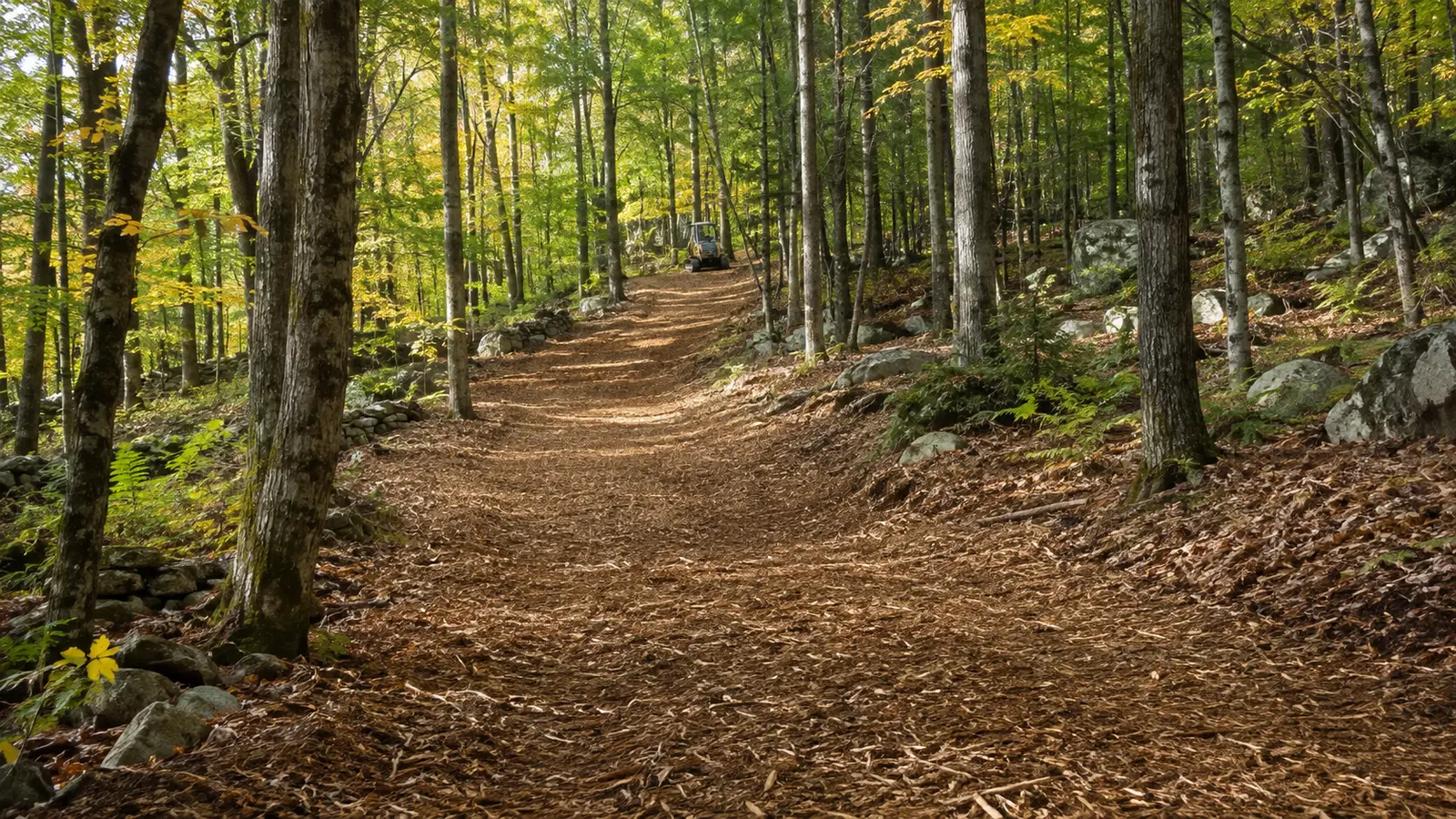
Photograph the slope from the side, not from the top or bottom — a downhill photograph flattens a slope and makes a serious grade look like a lawn. A shot from across the valley tells the truth.
The expensive mistake: Treating the fall-line percentage as the whole answer. A 30% grade worked straight up and down and a 30% grade worked across are different jobs, and the second one is where machines go over.
Doing it yourself: This is the one scope on the site where the honest answer is to stay off it. Landowner slope incidents with consumer machines are common and the consequences are severe. If the ground is steep enough to be a question, it is steep enough to be someone else's.
Afterwards: Watch the first heavy rain. Slopes tell you what you did to them the first time water runs across them, and the fix — matting, seed, a diversion — is small if it happens in the first season and large if it does not.

Side slope, soil, ledge, loose rock, wetness, stumps, escape paths, overhead hazards, and what lies below the machine all affect feasibility.
Photos and contours support screening; the operator still decides whether the machine can enter, work, turn, and leave safely.
For steep-terrain land clearing, write what stays, what goes, how material is handled, where machines may travel, and what the land should support next.
Boundary, easement, utility, road, permit, and owner authorization.
Vegetation, stem size, rock, wetness, debris, grade, and stable access.
Mulch, mow, cut, chip, fell, excavate, haul, or use a sequenced mix.
Finish tolerance, material location, restoration, inspection, and maintenance.
The 2 rules below were read from the agency or the statute on the date shown against each one. Nothing here is a determination for your parcel — the authority named is the one whose answer counts.
250 ft — Vermont, Shorelands
The Act regulates land within 250 feet of the mean water level of any lake larger than 10 acres. Creating "cleared area" — removing trees, shrubs or disturbing natural ground cover — needs a permit or a registration, the same as creating impervious surface.
Standards inside the protected shoreland: the site must be on a slope under 20%, no more than 20% of the parcel inside the area may be impervious, and no more than 40% may be cleared area. Registration B covers up to 500 sq ft of new cleared area or impervious surface between 100 and 250 feet from mean water level, if those three standards are met.
10 V.S.A. Chapter 49A, effective 1 July 2014 · Vermont DEC Lakes and Ponds Program · checked 2026-09-01 · source
1 acre — Vermont, Stormwater
Construction activity disturbing one acre or more of earth needs coverage under General Permit 3-9020 — and so does a smaller disturbance that is part of a larger common plan of development that will ultimately reach one acre.
Low Risk coverage caps concurrent disturbance at five acres and requires temporary or final stabilization within 14 days of the initial disturbance. Whether a mulching pass counts as "earth disturbance" depends on how much soil is exposed — ask the Stormwater Program before assuming it does not.
General Permit 3-9020 for Stormwater Runoff from Construction Sites · Vermont DEC Stormwater Program · checked 2026-09-01 · source
Low-ground-pressure tracked machines, and remote-controlled slope mowers where the grade or the exposure rules out an operator on board. Slope-aware brush and vegetation management for hillsides, banks, utility approaches, views, and hard-to-reach terrain. On a steep-Terrain Land Clearing job the scope should name the marked work limit, the retained vegetation, how material is handled, and the finish standard — those four decide the price far more than the acreage does.
Reduced from the flat-ground figure — expect 4–6 inches, because the limit is the machine's stability, not the head. That number is the single most useful thing to establish before anyone quotes steep-Terrain Land Clearing, because it decides which machine comes and how many passes the work takes.
A planning range of 0.2–0.8 acres per day. Slope work is slow because the machine repositions constantly, works across the fall line rather than up it, and stops for conditions a flat site would drive through. Production on a steep site is roughly half the equivalent flat site, and can be a third. This is a production screen, not a quote or a commitment to a schedule.
Low-ground-pressure tracked machines, and remote-controlled slope mowers where the grade or the exposure rules out an operator on board. Machine choice on a steep-Terrain Land Clearing job follows the access route and the ground condition as much as the vegetation — a carrier that suits the work is no use if it cannot reach it.
Vegetation reduced on ground ordinary equipment cannot safely work; Bank, hillside and roadside visibility restored; A view or solar corridor opened along a marked line; Ground left covered — on a slope, keeping the mulch layer is the erosion control. Anything beyond that list on a steep-Terrain Land Clearing project belongs in a separate, separately-priced scope.
Any change to the grade itself — that is excavation, on a slope, which is a different risk class; Slope stabilisation. Removing vegetation from a bank can reduce stability, not improve it.; A safety determination. Nothing in a photograph or a percentage makes a slope safe to work.. Every one of those is a real and common expectation, which is why steep-Terrain Land Clearing proposals should state them as exclusions rather than leaving them to be discovered at turnover.
Dry, firm conditions. Frozen ground helps flotation but ice on a side slope is the wrong trade — a hard, dry autumn is usually the best window.
Anything wet. Water in the soil is what turns a workable side slope into a machine on its side, and it is the single most common condition behind slope incidents.
Watch the first heavy rain. Slopes tell you what you did to them the first time water runs across them, and the fix — matting, seed, a diversion — is small if it happens in the first season and large if it does not.
Side slope, not just grade — a machine can climb far more than it can safely traverse. Side slope is the number that governs. What is below the work — a house, a road or a stream downhill changes the equipment and the method, not just the caution. Escape route — a slope with one way on and off is worked differently from one with a turnaround. Ledge and loose rock — both reduce traction and both are usually invisible under brush. Remote equipment — a remote-controlled machine expands what is possible and costs more per day.
Treating the fall-line percentage as the whole answer. A 30% grade worked straight up and down and a 30% grade worked across are different jobs, and the second one is where machines go over.
This is the one scope on the site where the honest answer is to stay off it. Landowner slope incidents with consumer machines are common and the consequences are severe. If the ground is steep enough to be a question, it is steep enough to be someone else's.
Photograph the slope from the side, not from the top or bottom — a downhill photograph flattens a slope and makes a serious grade look like a lawn. A shot from across the valley tells the truth.
No. A planning range for steep-Terrain Land Clearing is arithmetic on the numbers you entered — it has not seen the access route, the boundary, the wet ground, the rock, or the largest stem. Production alone spans 0.2–0.8 acres per day before anything else is considered, which is why a site review comes before a price.
It can, and on a steep-Terrain Land Clearing job it is settled before the machine is scheduled — photograph the slope from the side, not from the top or bottom — a downhill photograph flattens a slope and makes a serious grade look like a lawn. A shot from across the valley tells the truth. Shoreland Protection Act reaches 250 feet from mean water level (10 V.S.A. Chapter 49A, effective 1 July 2014). Standards inside the protected shoreland: the site must be on a slope under 20%, no more than 20% of the parcel inside the area may be impervious, and no more than 40% may be cleared area. Registration B covers up to 500 sq ft of new cleared area or impervious surface between 100 and 250 feet from mean water level, if those three standards are met. Checked against Vermont DEC Lakes and Ponds Program on 2026-09-01. Because steep-Terrain Land Clearing typically covers 0.2–0.8 acres per day, a stop part-way through for an approval that was never applied for costs more than the approval would have. The property owner is the applicant; a contractor's estimate is not a determination.
It can, and on a steep-Terrain Land Clearing job it is settled before the machine is scheduled — photograph the slope from the side, not from the top or bottom — a downhill photograph flattens a slope and makes a serious grade look like a lawn. A shot from across the valley tells the truth. One acre of earth disturbance triggers the Construction General Permit (General Permit 3-9020 for Stormwater Runoff from Construction Sites). Low Risk coverage caps concurrent disturbance at five acres and requires temporary or final stabilization within 14 days of the initial disturbance. Whether a mulching pass counts as "earth disturbance" depends on how much soil is exposed — ask the Stormwater Program before assuming it does not. Checked against Vermont DEC Stormwater Program on 2026-09-01. Because steep-Terrain Land Clearing typically covers 0.2–0.8 acres per day, a stop part-way through for an approval that was never applied for costs more than the approval would have. The property owner is the applicant; a contractor's estimate is not a determination.
Share the location, acreage, density, slope, access, photos, and intended outcome. We’ll turn the idea into a scope that can be evaluated on the property.
Request a site assessment↗Open the cost calculator →