Request a site assessment
Land capability

Forestry Mulching

One-machine land reclamation that cuts, grinds, and returns vegetation to the ground as a protective mulch layer.

Estimate clearing cost
Direct answer

What is forestry mulching and when is it the right choice?

Checked 2026-09-01

One-machine land reclamation that cuts, grinds, and returns vegetation to the ground as a protective mulch layer. A tracked carrier — skid steer, compact track loader or purpose-built mulcher — running a drum or disc mulching head, handling 6–8 inches for most carriers; 10+ inches only with a high-flow head and a slower pass. A planning range of 0.4–1.5 acres per day covers most projects — the spread is almost entirely stem density and stem size. Scattered saplings on flat, dry, open ground sit at the top of that range; a tangled 6-inch stand on a side slope with retained trees to work around sits at the bottom, and a rocky bench can halve it again. The best window is frozen or firm ground. Winter gives the best flotation, the least rutting, and clear sightlines with the leaves off, which is when a selective job is easiest to mark. It finishes standing vegetation reduced to a mulch layer spread across the ground, but not stumps and root balls — the head cuts at or near grade, it does not grub — those are separate, separately-priced scopes.

In practice

Process brush and woody growth where it stands.

Forestry mulching is often the cleanest fit when the goal is usable, visible, maintainable land rather than bare subsoil. A carrier and mulching head process compatible vegetation in place, which can limit truck traffic and leave organic material across the surface.

The right prescription depends on stem size, density, species, rock, slope, wetness, access, desired finish, and what happens after clearing. It is not a substitute for stump removal, grading, excavation, or permitted wetland work when those outcomes are required.

Best window: Frozen or firm ground. Winter gives the best flotation, the least rutting, and clear sightlines with the leaves off, which is when a selective job is easiest to mark.

Avoid: Mud season, roughly March into May in most of the region, when soft ground turns a clean pass into ruts that then need restoration. Nesting season is a habitat consideration rather than a soil one and is a separate conversation.

What drives the cost of forestry mulching
FactorWhat it does to the job
Stem densityThe single biggest factor. Doubling stems per acre roughly doubles the passes.
Largest stemA stand topping out at 3 inches and one topping out at 8 are different machines and different days.
Retained treesSelective work slows production more than most owners expect — the machine stops, repositions and works around instead of running a line.
Slope and side slopeAbove roughly 20% the machine works across rather than up, which cuts coverage per hour.
RockLedge and loose stone force the head up off the ground, leaving taller residual and risking teeth.
Access and transportOn a small parcel, getting the machine there can be a meaningful share of the day.
Forestry Mulching: what it finishes and what it does not
Included in this scopeStatus
Standing vegetation reduced to a mulch layer spread across the groundFinished by this scope
Immediate walkable and machine-passable accessFinished by this scope
Retained trees left standing where they were flaggedFinished by this scope
Soil left covered rather than exposedFinished by this scope
Stumps and root balls — the head cuts at or near grade, it does not grubNOT finished — price separately
A graded pad, a drainage profile, or subgrade for a road or foundationNOT finished — price separately
A lawn — mulch is not topsoil and the ground under it is not levelNOT finished — price separately
Permanent control of anything that resprouts from rootsNOT finished — price separately
Before you call

The one thing worth measuring first

Take a tape to the largest stem you can find in the work area and photograph it with the tape readable. That one number moves the estimate more than the acreage does.
The expensive mistake: Buying acreage instead of a finish standard. "Mulch two acres" and "leave nothing over four inches tall, mulch spread under three inches deep, these eleven trees untouched" are the same acreage and different jobs. The second one can be checked at turnover; the first one produces an argument.

Doing it yourself: A landowner with a brush saw and time can absolutely handle scattered saplings and an edge. The line is stem size and volume: once the material is thick enough that cutting it is easy but moving it is not, the machine is doing the part you cannot — it eliminates the pile.

Afterwards: Expect a response in the first full growing season. Sunlight now reaches ground that has been shaded for years, and both the seed bank and any cut root systems answer that. Plan the first inspection for the summer after the work, not three years later.

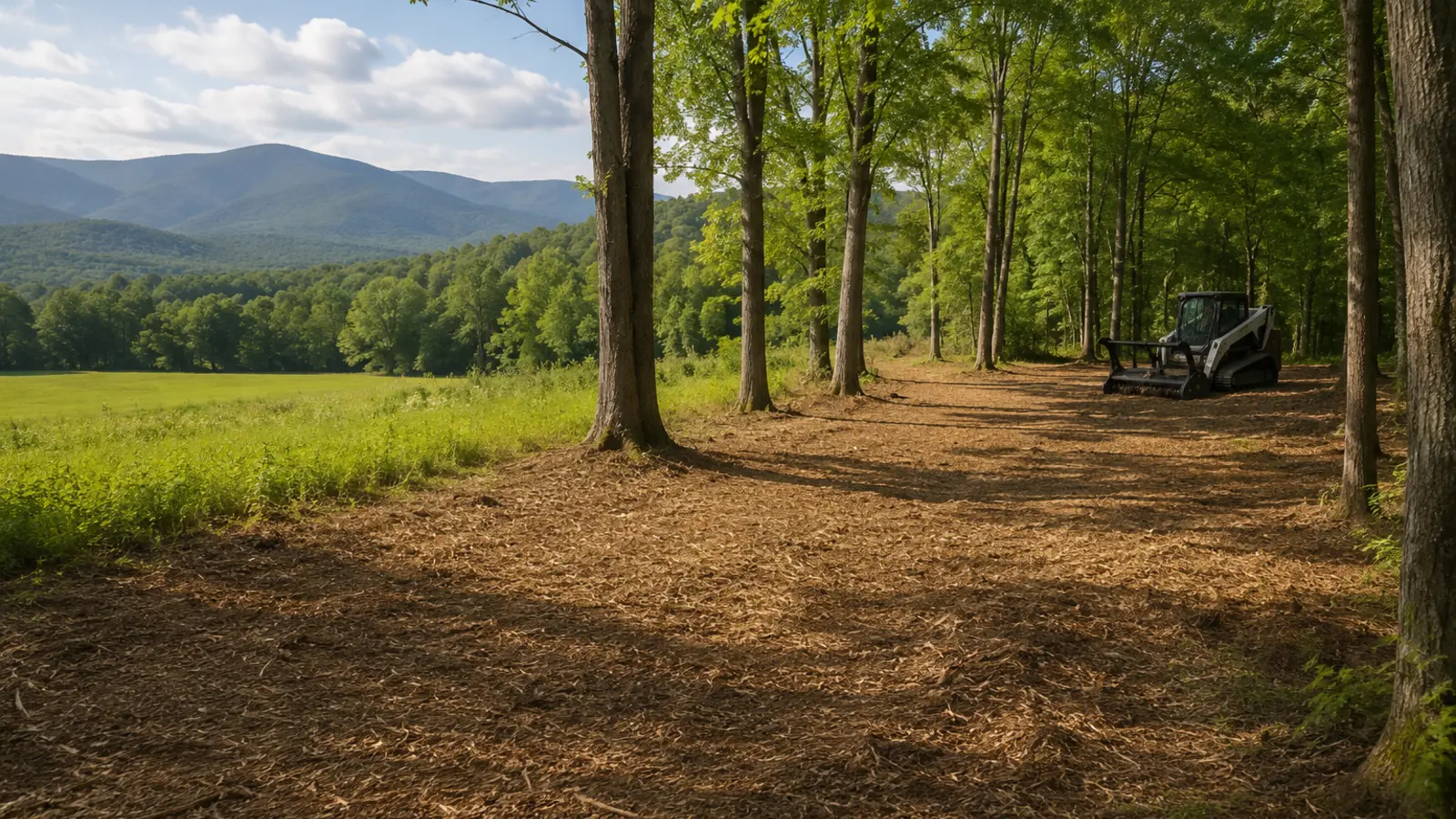
Selective vegetation clearing with retained trees and processed material
Illustrative finish, not a project claim. Actual results follow the marked work limit, vegetation, terrain, soil, access, and written turnover standard.
Field decision

Define the finish before selecting the method

Record compatible maximum stem size, retained trees, remaining material, mulch distribution, visible stump expectation, and the access route.

Mulching processes vegetation in place. Grubbing, grading, imported soil, drainage construction, and a lawn-ready seedbed are different scopes.

For forestry mulching, write what stays, what goes, how material is handled, where machines may travel, and what the land should support next.
A four-part project screen
01

Authority

Boundary, easement, utility, road, permit, and owner authorization.

02

Ground

Vegetation, stem size, rock, wetness, debris, grade, and stable access.

03

Method

Mulch, mow, cut, chip, fell, excavate, haul, or use a sequenced mix.

04

Closeout

Finish tolerance, material location, restoration, inspection, and maintenance.

Quote boundaries

Keep adjacent trades out of the gray area.

Define in this scopeOvergrown acreage and field edgesSaplings, brush, vines, and slashSelective clearing around retained treesReduced hauling and burn-pile needs
Price or verify separatelyTechnical tree work and riggingStump or root excavationGrading, drainage, and soilPermits, traffic control, treatment, or restoration
Verified against the primary source

What the rules say about forestry mulching

The 3 rules below were read from the agency or the statute on the date shown against each one. Nothing here is a determination for your parcel — the authority named is the one whose answer counts.

Class II wetlands carry a 50-foot buffer zone

50 ft — Vermont, Wetlands

A 50-foot buffer zone runs contiguous to the boundary of every Class II wetland, and most mapped wetlands in Vermont are Class II. Removing vegetation, filling, dredging, ditching, draining or grading inside the wetland or that buffer needs a Vermont Wetland Permit unless it is an Allowed Use under Section 6 of the rules.

Clearing vegetation is explicitly named in the regulated activities, so a mulching pass into a buffer is a permit question even though nothing is being built.

Vermont Wetland Rules; 10 V.S.A. Chapter 37 · Vermont DEC Wetlands Program · checked 2026-09-01 · source

Shoreland Protection Act reaches 250 feet from mean water level

250 ft — Vermont, Shorelands

The Act regulates land within 250 feet of the mean water level of any lake larger than 10 acres. Creating "cleared area" — removing trees, shrubs or disturbing natural ground cover — needs a permit or a registration, the same as creating impervious surface.

Standards inside the protected shoreland: the site must be on a slope under 20%, no more than 20% of the parcel inside the area may be impervious, and no more than 40% may be cleared area. Registration B covers up to 500 sq ft of new cleared area or impervious surface between 100 and 250 feet from mean water level, if those three standards are met.

10 V.S.A. Chapter 49A, effective 1 July 2014 · Vermont DEC Lakes and Ponds Program · checked 2026-09-01 · source

Clearing enrolled land can trigger the Land Use Change Tax

10% or 20% of FMV — Vermont, Property tax

Land in the Use Value Appraisal ("Current Use") program is taxed on its farm or forest use rather than market value. Developing it triggers a Land Use Change Tax of 10% or 20% of the fair market value of the developed portion, and for eligible forest land that obligation is perpetual.

The definition of "development" is the part that catches clearing projects: it includes construction of a building, road or structure, mining, excavation or landfill — and also cutting timber contrary to the property's forest or conservation management plan or the minimum acceptable standards for forest management. A clearing pass that a plan does not authorise is a tax event, not only a forestry one. More than 16,000 forestland parcels totalling over 2 million acres were enrolled as of 2026, so on Vermont acreage this is a likely question rather than an edge case.

32 V.S.A. Chapter 124 (Use Value Appraisal) · Vermont Department of Taxes / Department of Forests, Parks and Recreation · checked 2026-09-01 · source

Field questions

Know what the machine can—and cannot—solve.

01What does forestry Mulching actually involve?

A tracked carrier — skid steer, compact track loader or purpose-built mulcher — running a drum or disc mulching head. One-machine land reclamation that cuts, grinds, and returns vegetation to the ground as a protective mulch layer. On a forestry Mulching job the scope should name the marked work limit, the retained vegetation, how material is handled, and the finish standard — those four decide the price far more than the acreage does.

02What is the largest stem forestry Mulching can handle?

6–8 inches for most carriers; 10+ inches only with a high-flow head and a slower pass. That number is the single most useful thing to establish before anyone quotes forestry Mulching, because it decides which machine comes and how many passes the work takes.

03How much ground can forestry Mulching cover in a day?

A planning range of 0.4–1.5 acres per day. The spread is almost entirely stem density and stem size. Scattered saplings on flat, dry, open ground sit at the top of that range; a tangled 6-inch stand on a side slope with retained trees to work around sits at the bottom, and a rocky bench can halve it again. This is a production screen, not a quote or a commitment to a schedule.

04What equipment is used for forestry Mulching?

A tracked carrier — skid steer, compact track loader or purpose-built mulcher — running a drum or disc mulching head. Machine choice on a forestry Mulching job follows the access route and the ground condition as much as the vegetation — a carrier that suits the work is no use if it cannot reach it.

05What does forestry Mulching actually finish?

Standing vegetation reduced to a mulch layer spread across the ground; Immediate walkable and machine-passable access; Retained trees left standing where they were flagged; Soil left covered rather than exposed. Anything beyond that list on a forestry Mulching project belongs in a separate, separately-priced scope.

06What does forestry Mulching not finish?

Stumps and root balls — the head cuts at or near grade, it does not grub; A graded pad, a drainage profile, or subgrade for a road or foundation; A lawn — mulch is not topsoil and the ground under it is not level; Permanent control of anything that resprouts from roots. Every one of those is a real and common expectation, which is why forestry Mulching proposals should state them as exclusions rather than leaving them to be discovered at turnover.

07When is the best time of year for forestry Mulching?

Frozen or firm ground. Winter gives the best flotation, the least rutting, and clear sightlines with the leaves off, which is when a selective job is easiest to mark.

08When should forestry Mulching be avoided?

Mud season, roughly March into May in most of the region, when soft ground turns a clean pass into ruts that then need restoration. Nesting season is a habitat consideration rather than a soil one and is a separate conversation.

09What happens on the property after forestry Mulching is done?

Expect a response in the first full growing season. Sunlight now reaches ground that has been shaded for years, and both the seed bank and any cut root systems answer that. Plan the first inspection for the summer after the work, not three years later.

10What drives the cost of forestry Mulching?

Stem density — the single biggest factor. Doubling stems per acre roughly doubles the passes. Largest stem — a stand topping out at 3 inches and one topping out at 8 are different machines and different days. Retained trees — selective work slows production more than most owners expect — the machine stops, repositions and works around instead of running a line. Slope and side slope — above roughly 20% the machine works across rather than up, which cuts coverage per hour. Rock — ledge and loose stone force the head up off the ground, leaving taller residual and risking teeth. Access and transport — on a small parcel, getting the machine there can be a meaningful share of the day.

11What is the most expensive mistake on a forestry Mulching project?

Buying acreage instead of a finish standard. "Mulch two acres" and "leave nothing over four inches tall, mulch spread under three inches deep, these eleven trees untouched" are the same acreage and different jobs. The second one can be checked at turnover; the first one produces an argument.

12Can a landowner do forestry Mulching themselves?

A landowner with a brush saw and time can absolutely handle scattered saplings and an edge. The line is stem size and volume: once the material is thick enough that cutting it is easy but moving it is not, the machine is doing the part you cannot — it eliminates the pile.

13What should I measure before asking about forestry Mulching?

Take a tape to the largest stem you can find in the work area and photograph it with the tape readable. That one number moves the estimate more than the acreage does.

14Is an online range for forestry Mulching a quote?

No. A planning range for forestry Mulching is arithmetic on the numbers you entered — it has not seen the access route, the boundary, the wet ground, the rock, or the largest stem. Production alone spans 0.4–1.5 acres per day before anything else is considered, which is why a site review comes before a price.

15Does the wetlands rule in Vermont affect forestry Mulching?

It can, and on a forestry Mulching job it is settled before the machine is scheduled — take a tape to the largest stem you can find in the work area and photograph it with the tape readable. That one number moves the estimate more than the acreage does. Class II wetlands carry a 50-foot buffer zone (Vermont Wetland Rules; 10 V.S.A. Chapter 37). Clearing vegetation is explicitly named in the regulated activities, so a mulching pass into a buffer is a permit question even though nothing is being built. Checked against Vermont DEC Wetlands Program on 2026-09-01. Because forestry Mulching typically covers 0.4–1.5 acres per day, a stop part-way through for an approval that was never applied for costs more than the approval would have. The property owner is the applicant; a contractor's estimate is not a determination.

16Does the shorelands rule in Vermont affect forestry Mulching?

It can, and on a forestry Mulching job it is settled before the machine is scheduled — take a tape to the largest stem you can find in the work area and photograph it with the tape readable. That one number moves the estimate more than the acreage does. Shoreland Protection Act reaches 250 feet from mean water level (10 V.S.A. Chapter 49A, effective 1 July 2014). Standards inside the protected shoreland: the site must be on a slope under 20%, no more than 20% of the parcel inside the area may be impervious, and no more than 40% may be cleared area. Registration B covers up to 500 sq ft of new cleared area or impervious surface between 100 and 250 feet from mean water level, if those three standards are met. Checked against Vermont DEC Lakes and Ponds Program on 2026-09-01. Because forestry Mulching typically covers 0.4–1.5 acres per day, a stop part-way through for an approval that was never applied for costs more than the approval would have. The property owner is the applicant; a contractor's estimate is not a determination.

17Does the property tax rule in Vermont affect forestry Mulching?

It can, and on a forestry Mulching job it is settled before the machine is scheduled — take a tape to the largest stem you can find in the work area and photograph it with the tape readable. That one number moves the estimate more than the acreage does. Clearing enrolled land can trigger the Land Use Change Tax (32 V.S.A. Chapter 124 (Use Value Appraisal)). The definition of "development" is the part that catches clearing projects: it includes construction of a building, road or structure, mining, excavation or landfill — and also cutting timber contrary to the property's forest or conservation management plan or the minimum acceptable standards for forest management. A clearing pass that a plan does not authorise is a tax event, not only a forestry one. More than 16,000 forestland parcels totalling over 2 million acres were enrolled as of 2026, so on Vermont acreage this is a likely question rather than an edge case. Checked against Vermont Department of Taxes / Department of Forests, Parks and Recreation on 2026-09-01. Because forestry Mulching typically covers 0.4–1.5 acres per day, a stop part-way through for an approval that was never applied for costs more than the approval would have. The property owner is the applicant; a contractor's estimate is not a determination.

Start with the site

Turn forestry mulching into a marked scope.

Share the location, acreage, density, slope, access, photos, and intended outcome. We’ll turn the idea into a scope that can be evaluated on the property.

Request a site assessmentOpen the cost calculator →