Request a site assessment
Land capability

Commercial Land Clearing

Defined-scope vegetation clearing for builders, property managers, utilities, associations, farms, and commercial landowners.

Estimate clearing cost
Direct answer

How is commercial land clearing scoped and documented?

Checked 2026-09-01

Defined-scope vegetation clearing for builders, property managers, utilities, associations, farms, and commercial landowners. Whatever the phase requires, with the mobilisation for each phase priced separately, handling Site-dependent; commercial scopes usually mix methods rather than picking one. A planning range of Scoped by phase and documented per phase, not by a single day rate covers most projects — commercial work is priced around coordination as much as production. The vegetation is often the straightforward part; the traffic plan, the work-hour restrictions and the documentation are what shape the schedule. The best window is outside the growing season where the site allows, and outside the property's own busy period — on a commercial parcel, the tenant calendar often matters more than the weather. It finishes a mapped, signed limit of work executed to that map, but not anything outside the signed map — those are separate, separately-priced scopes.

In practice

Practical clearing for access, visibility, inspection, and development sequencing.

Commercial work needs a clear chain of authorization, maps, safety requirements, work-hour limits, traffic considerations, documentation, and coordination with other trades.

Project-based proposals can separate clearing, mobilization, disposal, erosion controls, traffic control, excavation, and follow-up so responsibility is visible.

Best window: Outside the growing season where the site allows, and outside the property's own busy period — on a commercial parcel, the tenant calendar often matters more than the weather.

Avoid: Any window where public exposure cannot be controlled.

What drives the cost of commercial land clearing
FactorWhat it does to the job
Public exposureTraffic control, pedestrian protection and hours restrictions.
Authorisation chainOne authorised representative is faster and cheaper than a committee.
DocumentationPhoto records, closeout reports and change-order process are billable and worth it.
PhasingSeparating mobilisation, clearing, hauling and restoration makes responsibility traceable.
Coordination with other tradesThe cost of a machine waiting is the same as the cost of a machine working.
Commercial Land Clearing: what it finishes and what it does not
Included in this scopeStatus
A mapped, signed limit of work executed to that mapFinished by this scope
Frontage, sightlines and inspection access restoredFinished by this scope
Each phase documented at handoverFinished by this scope
A recurring maintenance scope defined rather than assumedFinished by this scope
Anything outside the signed mapNOT finished — price separately
Utility work, traffic engineering or permittingNOT finished — price separately
Restoration and planting unless separately scopedNOT finished — price separately
Before you call

The one thing worth measuring first

Produce a marked-up site plan and get it signed by one person with authority. That single document prevents most of what goes wrong on commercial clearing.

The expensive mistake: Working from a verbal scope on a commercial parcel. Without a signed map and one named representative, the change orders arrive as disputes instead of as change orders.

Doing it yourself: No — the liability and documentation requirements put this firmly in contractor scope.

Afterwards: Commercial parcels are where a maintenance interval pays for itself fastest, because the alternative is a visible frontage going obviously neglected between rescues.

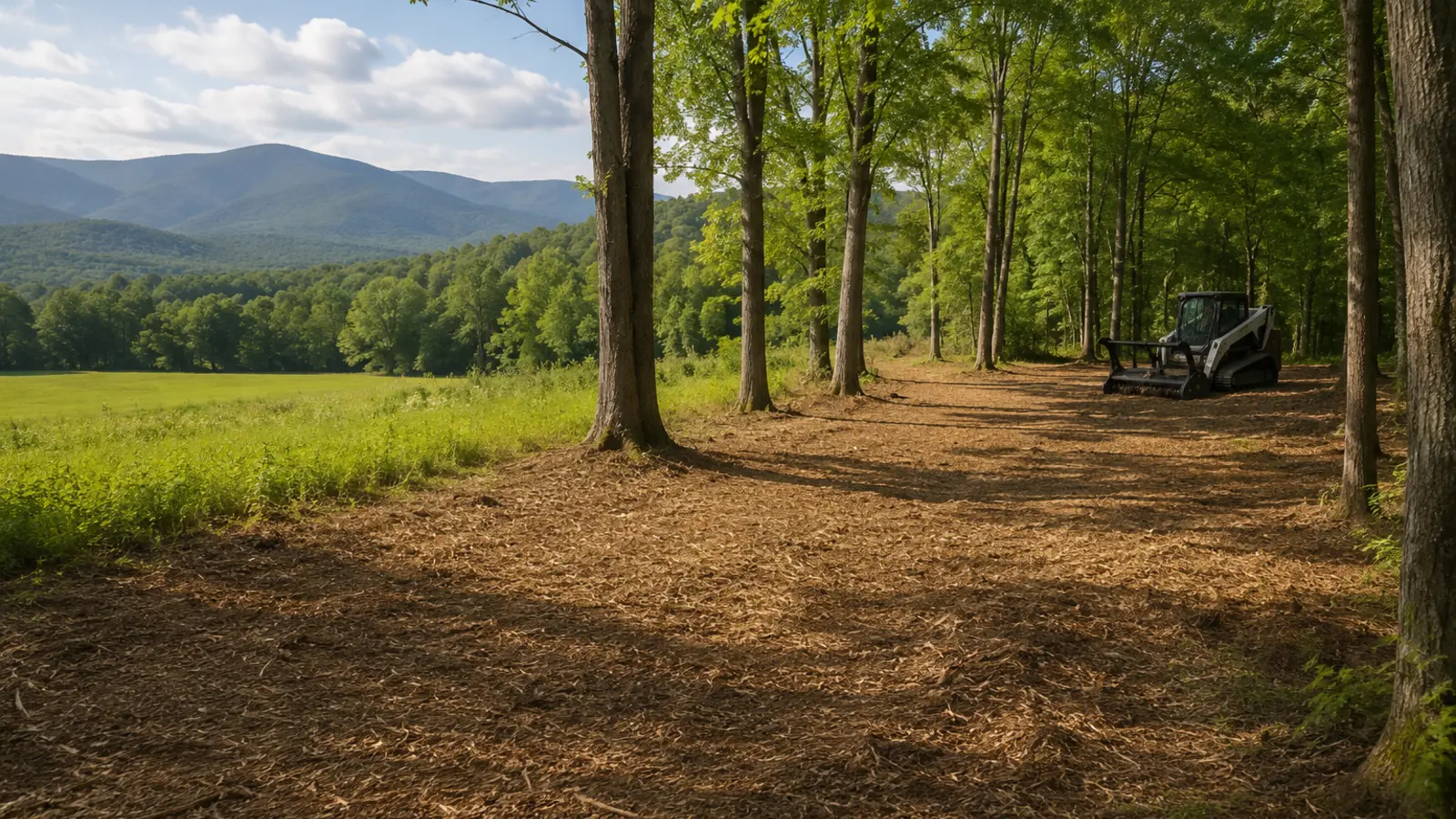
Selective vegetation clearing with retained trees and processed material
Illustrative finish, not a project claim. Actual results follow the marked work limit, vegetation, terrain, soil, access, and written turnover standard.
Field decision

Make authorization and coordination visible

Use a signed map, one owner representative, work-hour limits, traffic or public protection, utility coordination, documentation, and a change-order process.

Separate mobilization, clearing, tree work, excavation, material hauling, erosion control, restoration, and recurring maintenance so responsibility is traceable.

For commercial land clearing, write what stays, what goes, how material is handled, where machines may travel, and what the land should support next.
A four-part project screen
01

Authority

Boundary, easement, utility, road, permit, and owner authorization.

02

Ground

Vegetation, stem size, rock, wetness, debris, grade, and stable access.

03

Method

Mulch, mow, cut, chip, fell, excavate, haul, or use a sequenced mix.

04

Closeout

Finish tolerance, material location, restoration, inspection, and maintenance.

Quote boundaries

Keep adjacent trades out of the gray area.

Define in this scopeFrontage and sightline cleanupEarly access and investigationFence and drainage corridorsPhased site maintenance
Price or verify separatelyTechnical tree work and riggingStump or root excavationGrading, drainage, and soilPermits, traffic control, treatment, or restoration
Verified against the primary source

What the rules say about commercial land clearing

The 1 rule below was read from the agency or the statute on the date shown against each one. Nothing here is a determination for your parcel — the authority named is the one whose answer counts.

One acre of earth disturbance triggers the Construction General Permit

1 acre — Vermont, Stormwater

Construction activity disturbing one acre or more of earth needs coverage under General Permit 3-9020 — and so does a smaller disturbance that is part of a larger common plan of development that will ultimately reach one acre.

Low Risk coverage caps concurrent disturbance at five acres and requires temporary or final stabilization within 14 days of the initial disturbance. Whether a mulching pass counts as "earth disturbance" depends on how much soil is exposed — ask the Stormwater Program before assuming it does not.

General Permit 3-9020 for Stormwater Runoff from Construction Sites · Vermont DEC Stormwater Program · checked 2026-09-01 · source

Does this project fall under Act 250?

Act 250 jurisdiction turns on the purpose of the work, the acreage, whether the town has permanent zoning and subdivision bylaws, road construction, and prior activity within a five-mile radius over five years. The tier framework enacted in Act 181 of 2024 is still being phased in and the thresholds have moved during that phase-in.

Ask: Request a jurisdictional opinion from the District Coordinator for the district the parcel sits in. That opinion is the determination — no contractor estimate, map or calculator substitutes for it.

Vermont Natural Resources Board, District Commissions · source · checked 2026-09-01

Field questions

Know what the machine can—and cannot—solve.

01What does commercial Land Clearing actually involve?

Whatever the phase requires, with the mobilisation for each phase priced separately. Defined-scope vegetation clearing for builders, property managers, utilities, associations, farms, and commercial landowners. On a commercial Land Clearing job the scope should name the marked work limit, the retained vegetation, how material is handled, and the finish standard — those four decide the price far more than the acreage does.

02What is the largest stem commercial Land Clearing can handle?

Site-dependent; commercial scopes usually mix methods rather than picking one. That number is the single most useful thing to establish before anyone quotes commercial Land Clearing, because it decides which machine comes and how many passes the work takes.

03How much ground can commercial Land Clearing cover in a day?

A planning range of Scoped by phase and documented per phase, not by a single day rate. Commercial work is priced around coordination as much as production. The vegetation is often the straightforward part; the traffic plan, the work-hour restrictions and the documentation are what shape the schedule. This is a production screen, not a quote or a commitment to a schedule.

04What equipment is used for commercial Land Clearing?

Whatever the phase requires, with the mobilisation for each phase priced separately. Machine choice on a commercial Land Clearing job follows the access route and the ground condition as much as the vegetation — a carrier that suits the work is no use if it cannot reach it.

05What does commercial Land Clearing actually finish?

A mapped, signed limit of work executed to that map; Frontage, sightlines and inspection access restored; Each phase documented at handover; A recurring maintenance scope defined rather than assumed. Anything beyond that list on a commercial Land Clearing project belongs in a separate, separately-priced scope.

06What does commercial Land Clearing not finish?

Anything outside the signed map; Utility work, traffic engineering or permitting; Restoration and planting unless separately scoped. Every one of those is a real and common expectation, which is why commercial Land Clearing proposals should state them as exclusions rather than leaving them to be discovered at turnover.

07When is the best time of year for commercial Land Clearing?

Outside the growing season where the site allows, and outside the property's own busy period — on a commercial parcel, the tenant calendar often matters more than the weather.

08When should commercial Land Clearing be avoided?

Any window where public exposure cannot be controlled.

09What happens on the property after commercial Land Clearing is done?

Commercial parcels are where a maintenance interval pays for itself fastest, because the alternative is a visible frontage going obviously neglected between rescues.

10What drives the cost of commercial Land Clearing?

Public exposure — traffic control, pedestrian protection and hours restrictions. Authorisation chain — one authorised representative is faster and cheaper than a committee. Documentation — photo records, closeout reports and change-order process are billable and worth it. Phasing — separating mobilisation, clearing, hauling and restoration makes responsibility traceable. Coordination with other trades — the cost of a machine waiting is the same as the cost of a machine working.

11What is the most expensive mistake on a commercial Land Clearing project?

Working from a verbal scope on a commercial parcel. Without a signed map and one named representative, the change orders arrive as disputes instead of as change orders.

12Can a landowner do commercial Land Clearing themselves?

No — the liability and documentation requirements put this firmly in contractor scope.

13What should I measure before asking about commercial Land Clearing?

Produce a marked-up site plan and get it signed by one person with authority. That single document prevents most of what goes wrong on commercial clearing.

14Is an online range for commercial Land Clearing a quote?

No. A planning range for commercial Land Clearing is arithmetic on the numbers you entered — it has not seen the access route, the boundary, the wet ground, the rock, or the largest stem. Production alone spans Scoped by phase and documented per phase, not by a single day rate before anything else is considered, which is why a site review comes before a price.

15Does the stormwater rule in Vermont affect commercial Land Clearing?

It can, and on a commercial Land Clearing job it is settled before the machine is scheduled — produce a marked-up site plan and get it signed by one person with authority. That single document prevents most of what goes wrong on commercial clearing. One acre of earth disturbance triggers the Construction General Permit (General Permit 3-9020 for Stormwater Runoff from Construction Sites). Low Risk coverage caps concurrent disturbance at five acres and requires temporary or final stabilization within 14 days of the initial disturbance. Whether a mulching pass counts as "earth disturbance" depends on how much soil is exposed — ask the Stormwater Program before assuming it does not. Checked against Vermont DEC Stormwater Program on 2026-09-01. Because commercial Land Clearing typically covers Scoped by phase and documented per phase, not by a single day rate, a stop part-way through for an approval that was never applied for costs more than the approval would have. The property owner is the applicant; a contractor's estimate is not a determination.

16Does this project fall under Act 250? — how does that apply to commercial Land Clearing?

Act 250 jurisdiction turns on the purpose of the work, the acreage, whether the town has permanent zoning and subdivision bylaws, road construction, and prior activity within a five-mile radius over five years. The tier framework enacted in Act 181 of 2024 is still being phased in and the thresholds have moved during that phase-in. Request a jurisdictional opinion from the District Coordinator for the district the parcel sits in. That opinion is the determination — no contractor estimate, map or calculator substitutes for it. On a commercial Land Clearing job specifically this comes before scheduling, not during: the machine handles Site-dependent; commercial scopes usually mix methods rather than picking one, and it cannot tell the difference between what it is meant to cut and what it is not.

Start with the site

Turn commercial land clearing into a marked scope.

Share the location, acreage, density, slope, access, photos, and intended outcome. We’ll turn the idea into a scope that can be evaluated on the property.

Request a site assessmentOpen the cost calculator →