Authority
Boundary, easement, utility, road, permit, and owner authorization.
Vegetation clearing along private roads, driveways, culverts, ditches, embankments, and drainage infrastructure.
Estimate clearing cost↗Checked 2026-09-01
Vegetation clearing along private roads, driveways, culverts, ditches, embankments, and drainage infrastructure. Boom-mounted or tracked mulching head, worked from the road surface or the shoulder depending on the bank, handling 3–6 inches within the corridor. A planning range of 500–2,000 linear feet per day covers most projects — roadside production is linear and reasonably predictable until traffic or a bank steepens. A private road with no traffic runs at the top; a public-facing frontage with flaggers runs at the bottom. The best window is autumn, after the growing season and before winter maintenance needs the sight lines and the ditches working. It finishes sight distance restored at entries, corners and intersections, but not any reshaping of the ditch itself, which is excavation in a drainage feature — those are separate, separately-priced scopes.
Roadside work should begin with ownership, right-of-way, utility, traffic, drainage, and slope review. Cutting vegetation is not permission to reshape a ditch, disturb a stream, or place mulch where it can wash into a culvert.
A practical scope identifies the corridor width, sight triangles, retained shade or screening, downhill exposure, public protection, material placement, and the separate need for excavation or erosion controls.
Best window: Autumn, after the growing season and before winter maintenance needs the sight lines and the ditches working.
Avoid: Wet conditions where cut material can wash into a culvert and block the thing the job was meant to protect.
| Factor | What it does to the job |
|---|---|
| Traffic exposure | Public road frontage brings a traffic plan and its daily cost. |
| Bank steepness | A steep bank decides whether the machine reaches from the road or has to get onto it. |
| Corridor length and width | The two numbers the estimate is actually built on. |
| Material placement | Where the mulch is allowed to end up, given the drainage. |
| Authority | Private road, town road and state highway are three different permission processes. |
| Included in this scope | Status |
|---|---|
| Sight distance restored at entries, corners and intersections | Finished by this scope |
| Culvert inlets and outlets visible and reachable for maintenance | Finished by this scope |
| Ditch lines visible enough to be inspected | Finished by this scope |
| Banks cut back to a line a maintenance pass can hold | Finished by this scope |
| Any reshaping of the ditch itself, which is excavation in a drainage feature | NOT finished — price separately |
| Culvert repair or replacement | NOT finished — price separately |
| Authority over a public right-of-way, which belongs to the road authority | NOT finished — price separately |
Stand at the driver's eye position at each entry and photograph the sight line in both directions. Those photos define what "cleared" has to mean here.
The expensive mistake: Treating the ditch as somewhere to put the material. Mulch in a ditch travels to the culvert, blocks it, and the resulting washout costs more than the clearing did.
Doing it yourself: On a private drive with a walk-behind mower, within reason. On anything with public traffic, no — the traffic exposure is the risk, not the vegetation.
Afterwards: Check the culverts after the first heavy rain following the work. Mulch placed carelessly near an inlet is the most common way this scope creates the problem it was hired to prevent.
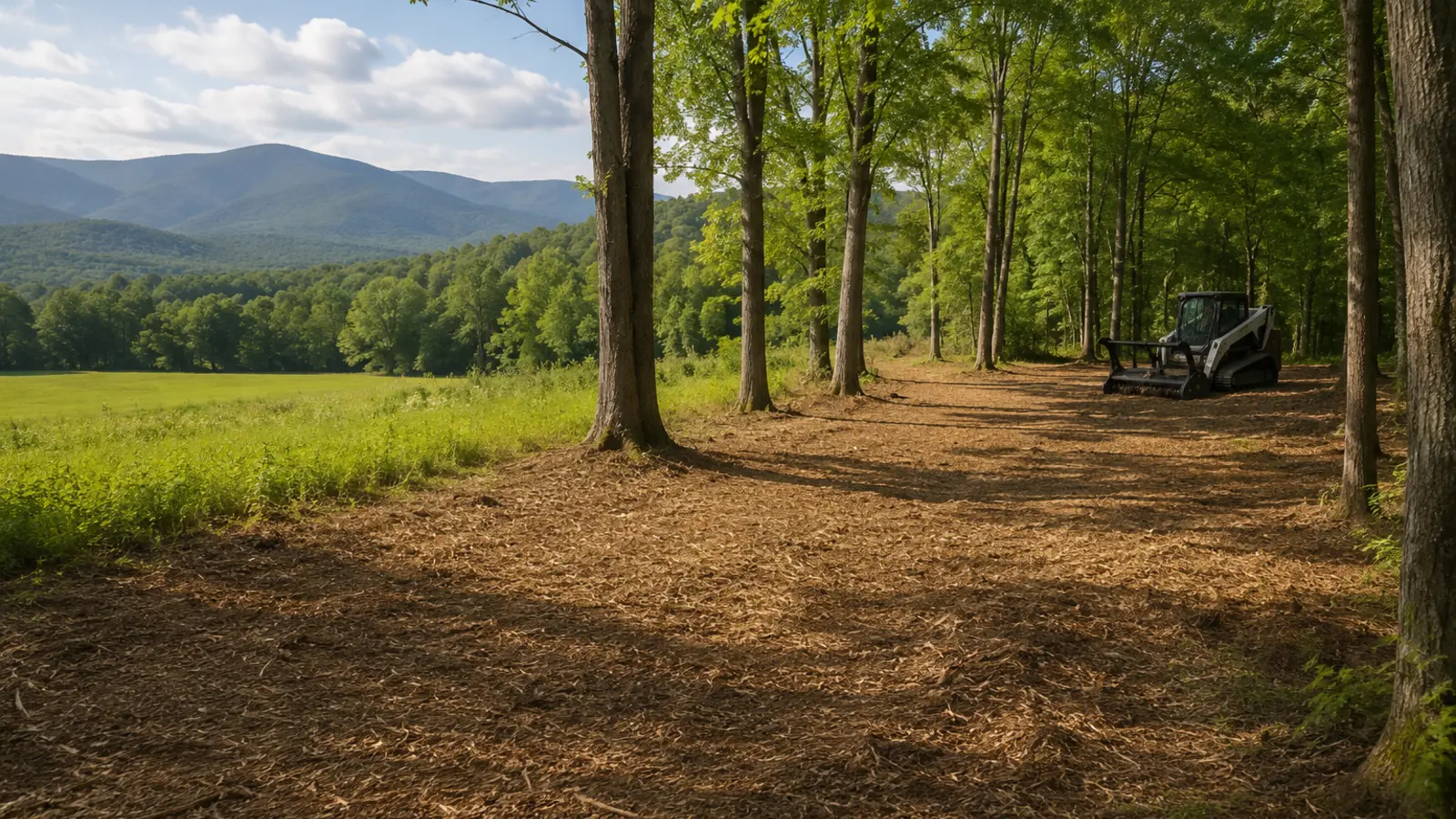
Use a signed map, one owner representative, work-hour limits, traffic or public protection, utility coordination, documentation, and a change-order process.
Separate mobilization, clearing, tree work, excavation, material hauling, erosion control, restoration, and recurring maintenance so responsibility is traceable.
For roadside, ditch & drainage clearing, write what stays, what goes, how material is handled, where machines may travel, and what the land should support next.
Boundary, easement, utility, road, permit, and owner authorization.
Vegetation, stem size, rock, wetness, debris, grade, and stable access.
Mulch, mow, cut, chip, fell, excavate, haul, or use a sequenced mix.
Finish tolerance, material location, restoration, inspection, and maintenance.
The 2 rules below were read from the agency or the statute on the date shown against each one. Nothing here is a determination for your parcel — the authority named is the one whose answer counts.
1 acre — Vermont, Stormwater
Construction activity disturbing one acre or more of earth needs coverage under General Permit 3-9020 — and so does a smaller disturbance that is part of a larger common plan of development that will ultimately reach one acre.
Low Risk coverage caps concurrent disturbance at five acres and requires temporary or final stabilization within 14 days of the initial disturbance. Whether a mulching pass counts as "earth disturbance" depends on how much soil is exposed — ask the Stormwater Program before assuming it does not.
General Permit 3-9020 for Stormwater Runoff from Construction Sites · Vermont DEC Stormwater Program · checked 2026-09-01 · source
50 ft — Vermont, Wetlands
A 50-foot buffer zone runs contiguous to the boundary of every Class II wetland, and most mapped wetlands in Vermont are Class II. Removing vegetation, filling, dredging, ditching, draining or grading inside the wetland or that buffer needs a Vermont Wetland Permit unless it is an Allowed Use under Section 6 of the rules.
Clearing vegetation is explicitly named in the regulated activities, so a mulching pass into a buffer is a permit question even though nothing is being built.
Vermont Wetland Rules; 10 V.S.A. Chapter 37 · Vermont DEC Wetlands Program · checked 2026-09-01 · source
Boom-mounted or tracked mulching head, worked from the road surface or the shoulder depending on the bank. Vegetation clearing along private roads, driveways, culverts, ditches, embankments, and drainage infrastructure. On a roadside, Ditch & Drainage Clearing job the scope should name the marked work limit, the retained vegetation, how material is handled, and the finish standard — those four decide the price far more than the acreage does.
3–6 inches within the corridor. That number is the single most useful thing to establish before anyone quotes roadside, Ditch & Drainage Clearing, because it decides which machine comes and how many passes the work takes.
A planning range of 500–2,000 linear feet per day. Roadside production is linear and reasonably predictable until traffic or a bank steepens. A private road with no traffic runs at the top; a public-facing frontage with flaggers runs at the bottom. This is a production screen, not a quote or a commitment to a schedule.
Boom-mounted or tracked mulching head, worked from the road surface or the shoulder depending on the bank. Machine choice on a roadside, Ditch & Drainage Clearing job follows the access route and the ground condition as much as the vegetation — a carrier that suits the work is no use if it cannot reach it.
Sight distance restored at entries, corners and intersections; Culvert inlets and outlets visible and reachable for maintenance; Ditch lines visible enough to be inspected; Banks cut back to a line a maintenance pass can hold. Anything beyond that list on a roadside, Ditch & Drainage Clearing project belongs in a separate, separately-priced scope.
Any reshaping of the ditch itself, which is excavation in a drainage feature; Culvert repair or replacement; Authority over a public right-of-way, which belongs to the road authority. Every one of those is a real and common expectation, which is why roadside, Ditch & Drainage Clearing proposals should state them as exclusions rather than leaving them to be discovered at turnover.
Autumn, after the growing season and before winter maintenance needs the sight lines and the ditches working.
Wet conditions where cut material can wash into a culvert and block the thing the job was meant to protect.
Check the culverts after the first heavy rain following the work. Mulch placed carelessly near an inlet is the most common way this scope creates the problem it was hired to prevent.
Traffic exposure — public road frontage brings a traffic plan and its daily cost. Bank steepness — a steep bank decides whether the machine reaches from the road or has to get onto it. Corridor length and width — the two numbers the estimate is actually built on. Material placement — where the mulch is allowed to end up, given the drainage. Authority — private road, town road and state highway are three different permission processes.
Treating the ditch as somewhere to put the material. Mulch in a ditch travels to the culvert, blocks it, and the resulting washout costs more than the clearing did.
On a private drive with a walk-behind mower, within reason. On anything with public traffic, no — the traffic exposure is the risk, not the vegetation.
Stand at the driver's eye position at each entry and photograph the sight line in both directions. Those photos define what "cleared" has to mean here.
No. A planning range for roadside, Ditch & Drainage Clearing is arithmetic on the numbers you entered — it has not seen the access route, the boundary, the wet ground, the rock, or the largest stem. Production alone spans 500–2,000 linear feet per day before anything else is considered, which is why a site review comes before a price.
It can, and on a roadside, Ditch & Drainage Clearing job it is settled before the machine is scheduled — stand at the driver's eye position at each entry and photograph the sight line in both directions. Those photos define what "cleared" has to mean here. One acre of earth disturbance triggers the Construction General Permit (General Permit 3-9020 for Stormwater Runoff from Construction Sites). Low Risk coverage caps concurrent disturbance at five acres and requires temporary or final stabilization within 14 days of the initial disturbance. Whether a mulching pass counts as "earth disturbance" depends on how much soil is exposed — ask the Stormwater Program before assuming it does not. Checked against Vermont DEC Stormwater Program on 2026-09-01. Because roadside, Ditch & Drainage Clearing typically covers 500–2,000 linear feet per day, a stop part-way through for an approval that was never applied for costs more than the approval would have. The property owner is the applicant; a contractor's estimate is not a determination.
It can, and on a roadside, Ditch & Drainage Clearing job it is settled before the machine is scheduled — stand at the driver's eye position at each entry and photograph the sight line in both directions. Those photos define what "cleared" has to mean here. Class II wetlands carry a 50-foot buffer zone (Vermont Wetland Rules; 10 V.S.A. Chapter 37). Clearing vegetation is explicitly named in the regulated activities, so a mulching pass into a buffer is a permit question even though nothing is being built. Checked against Vermont DEC Wetlands Program on 2026-09-01. Because roadside, Ditch & Drainage Clearing typically covers 500–2,000 linear feet per day, a stop part-way through for an approval that was never applied for costs more than the approval would have. The property owner is the applicant; a contractor's estimate is not a determination.
Share the location, acreage, density, slope, access, photos, and intended outcome. We’ll turn the idea into a scope that can be evaluated on the property.
Request a site assessment↗Open the cost calculator →