Request a site assessment
Land capability

Pasture & Farm Reclamation

Clear field edges, volunteer trees, brush, lanes, fence corridors, and neglected paddocks for the next agricultural step.

Estimate clearing cost
Direct answer

How do I turn an overgrown field back into pasture?

Checked 2026-09-01

Clear field edges, volunteer trees, brush, lanes, fence corridors, and neglected paddocks for the next agricultural step. Mulcher for the reset, then whatever the agronomic plan needs — and that part is usually somebody else, handling 6–8 inches for the clearing pass; the constraint is what the ground has to become, not what is on it. A planning range of 0.5–1.5 acres per day for the clearing; the agronomic work runs on a season, not a day rate covers most projects — the clearing half is ordinary mulching production. The reason a pasture project takes a year is that the ground is not pasture when the machine leaves — mulch has to break down or be dealt with, soil has to be tested and corrected, and seed has to establish. The best window is clear in winter, correct soil and seed the following spring or late summer. Splitting the project across a season boundary is the normal, correct shape for this scope. It finishes encroaching woody growth removed from field, edge and lane, but not pasture. A mulched field is not grazeable ground and putting stock on it is a bad idea. — those are separate, separately-priced scopes.

In practice

Return encroaching acreage to productive management.

Reclaiming a field requires a finish plan. Mulched woody material may need time, collection, soil work, seeding, lime, or other agronomic steps before grazing or hay production.

The clearing contractor should coordinate with the landowner, excavator, fencing contractor, forester, or crop adviser when the end use needs more than vegetation removal.

Best window: Clear in winter, correct soil and seed the following spring or late summer. Splitting the project across a season boundary is the normal, correct shape for this scope.

Avoid: Clearing and seeding in the same pass. Mulch depth and undecomposed woody residue interfere with seed-to-soil contact and the seeding fails.

What drives the cost of pasture & farm reclamation
FactorWhat it does to the job
Woody stem sizeVolunteer trees at 6 inches are a different pass than brush at 2.
StumpsWhether they come out decides if the ground is mowable or only mulchable.
Residue handlingLeaving mulch, raking it, or hauling it are three prices and three timelines to grazing.
Soil correctionLime and seed on reverting ground is a real per-acre cost, separate from clearing.
Fence and waterUsually the item that decides when stock can actually go on.
Pasture & Farm Reclamation: what it finishes and what it does not
Included in this scopeStatus
Encroaching woody growth removed from field, edge and laneFinished by this scope
The original field boundary re-established and visibleFinished by this scope
Fence corridors and water lines reachable againFinished by this scope
A surface that can be worked toward pasture, with a plan for howFinished by this scope
Pasture. A mulched field is not grazeable ground and putting stock on it is a bad idea.NOT finished — price separately
The soil work — testing, lime, fertility, seedbed preparationNOT finished — price separately
The stumps, which a mowing machine will find later if they are not dealt withNOT finished — price separately
Before you call

The one thing worth measuring first

Find the old field boundary — on an aerial, in the stone walls, or in the change in soil — and mark it. Reclaiming to the historic edge is almost always the right target and it is usually further out than it looks.
The expensive mistake: Budgeting the clearing and calling it the project. Clearing is often the smaller half of getting a field back into production, and a landowner who has spent the whole budget on the machine has a cleared field and no pasture.

Doing it yourself: The agronomic half is very landowner-doable and is where the money is best spent carefully — soil test, lime, seed choice, and the patience to wait a season. The clearing half usually is not.

Afterwards: Get a soil test before buying anything. Reverting field ground in this region is commonly acidic and low in phosphorus, and lime takes months to act, so the test date drives the whole calendar.

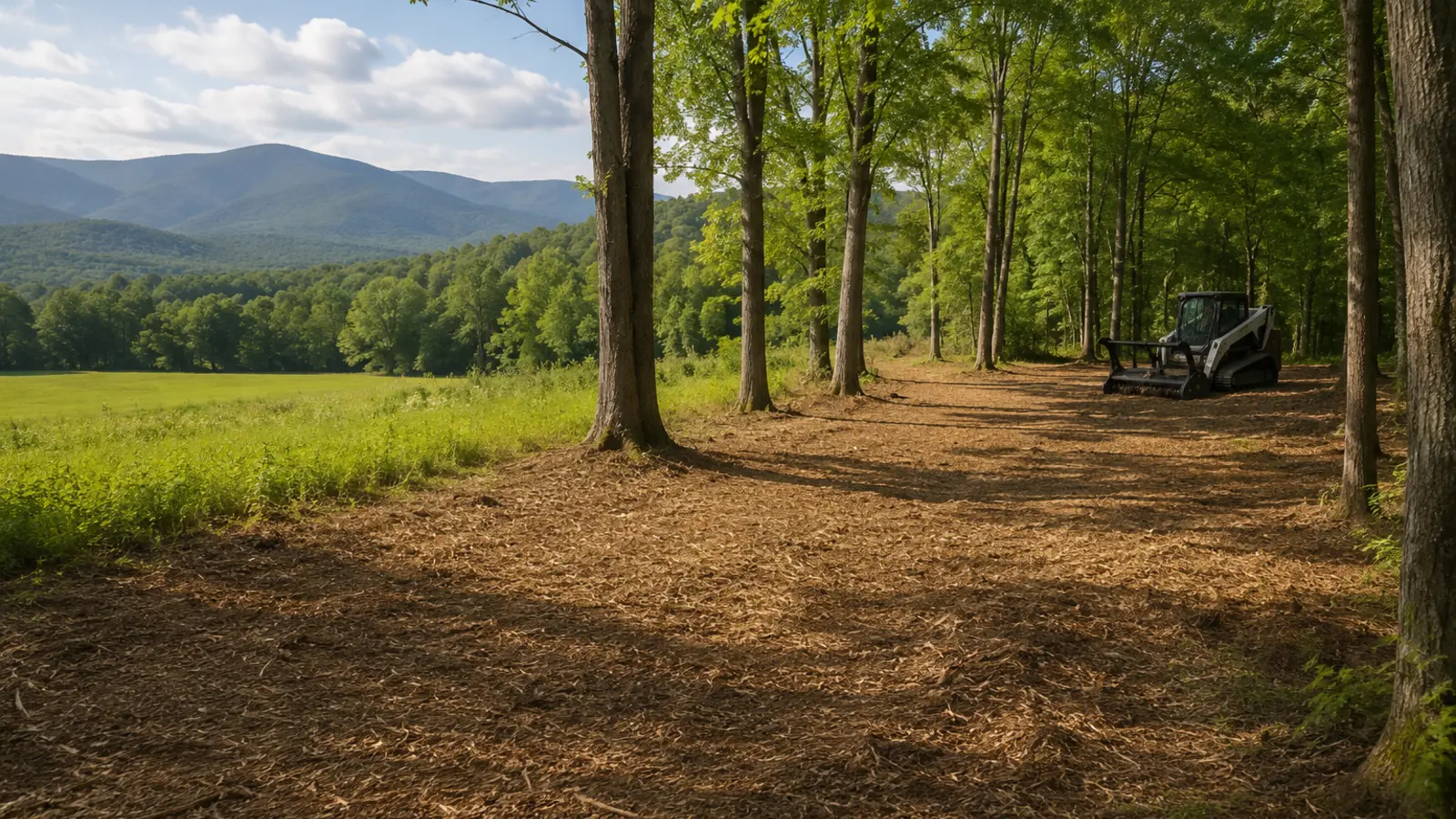
Selective vegetation clearing with retained trees and processed material
Illustrative finish, not a project claim. Actual results follow the marked work limit, vegetation, terrain, soil, access, and written turnover standard.
Field decision

Clear for the next land use

Pasture, orchard, sugarbush, hunting, trail, and farm projects succeed when the clearing width and finish match the next operation.

Coordinate soil, seed, fencing, water, drainage, crop, forestry, or habitat decisions with the appropriate professional after access is restored.

For pasture & farm reclamation, write what stays, what goes, how material is handled, where machines may travel, and what the land should support next.
A four-part project screen
01

Authority

Boundary, easement, utility, road, permit, and owner authorization.

02

Ground

Vegetation, stem size, rock, wetness, debris, grade, and stable access.

03

Method

Mulch, mow, cut, chip, fell, excavate, haul, or use a sequenced mix.

04

Closeout

Finish tolerance, material location, restoration, inspection, and maintenance.

Quote boundaries

Keep adjacent trades out of the gray area.

Define in this scopePasture expansion and recoveryFarm-road and lane accessFence and water-line corridorsOrchard and sugarbush access
Price or verify separatelyTechnical tree work and riggingStump or root excavationGrading, drainage, and soilPermits, traffic control, treatment, or restoration
Verified against the primary source

What the rules say about pasture & farm reclamation

The 2 rules below were read from the agency or the statute on the date shown against each one. Nothing here is a determination for your parcel — the authority named is the one whose answer counts.

Clearing enrolled land can trigger the Land Use Change Tax

10% or 20% of FMV — Vermont, Property tax

Land in the Use Value Appraisal ("Current Use") program is taxed on its farm or forest use rather than market value. Developing it triggers a Land Use Change Tax of 10% or 20% of the fair market value of the developed portion, and for eligible forest land that obligation is perpetual.

The definition of "development" is the part that catches clearing projects: it includes construction of a building, road or structure, mining, excavation or landfill — and also cutting timber contrary to the property's forest or conservation management plan or the minimum acceptable standards for forest management. A clearing pass that a plan does not authorise is a tax event, not only a forestry one. More than 16,000 forestland parcels totalling over 2 million acres were enrolled as of 2026, so on Vermont acreage this is a likely question rather than an edge case.

32 V.S.A. Chapter 124 (Use Value Appraisal) · Vermont Department of Taxes / Department of Forests, Parks and Recreation · checked 2026-09-01 · source

Class II wetlands carry a 50-foot buffer zone

50 ft — Vermont, Wetlands

A 50-foot buffer zone runs contiguous to the boundary of every Class II wetland, and most mapped wetlands in Vermont are Class II. Removing vegetation, filling, dredging, ditching, draining or grading inside the wetland or that buffer needs a Vermont Wetland Permit unless it is an Allowed Use under Section 6 of the rules.

Clearing vegetation is explicitly named in the regulated activities, so a mulching pass into a buffer is a permit question even though nothing is being built.

Vermont Wetland Rules; 10 V.S.A. Chapter 37 · Vermont DEC Wetlands Program · checked 2026-09-01 · source

Field questions

Know what the machine can—and cannot—solve.

01What does pasture & Farm Reclamation actually involve?

Mulcher for the reset, then whatever the agronomic plan needs — and that part is usually somebody else. Clear field edges, volunteer trees, brush, lanes, fence corridors, and neglected paddocks for the next agricultural step. On a pasture & Farm Reclamation job the scope should name the marked work limit, the retained vegetation, how material is handled, and the finish standard — those four decide the price far more than the acreage does.

02What is the largest stem pasture & Farm Reclamation can handle?

6–8 inches for the clearing pass; the constraint is what the ground has to become, not what is on it. That number is the single most useful thing to establish before anyone quotes pasture & Farm Reclamation, because it decides which machine comes and how many passes the work takes.

03How much ground can pasture & Farm Reclamation cover in a day?

A planning range of 0.5–1.5 acres per day for the clearing; the agronomic work runs on a season, not a day rate. The clearing half is ordinary mulching production. The reason a pasture project takes a year is that the ground is not pasture when the machine leaves — mulch has to break down or be dealt with, soil has to be tested and corrected, and seed has to establish. This is a production screen, not a quote or a commitment to a schedule.

04What equipment is used for pasture & Farm Reclamation?

Mulcher for the reset, then whatever the agronomic plan needs — and that part is usually somebody else. Machine choice on a pasture & Farm Reclamation job follows the access route and the ground condition as much as the vegetation — a carrier that suits the work is no use if it cannot reach it.

05What does pasture & Farm Reclamation actually finish?

Encroaching woody growth removed from field, edge and lane; The original field boundary re-established and visible; Fence corridors and water lines reachable again; A surface that can be worked toward pasture, with a plan for how. Anything beyond that list on a pasture & Farm Reclamation project belongs in a separate, separately-priced scope.

06What does pasture & Farm Reclamation not finish?

Pasture. A mulched field is not grazeable ground and putting stock on it is a bad idea.; The soil work — testing, lime, fertility, seedbed preparation; The stumps, which a mowing machine will find later if they are not dealt with. Every one of those is a real and common expectation, which is why pasture & Farm Reclamation proposals should state them as exclusions rather than leaving them to be discovered at turnover.

07When is the best time of year for pasture & Farm Reclamation?

Clear in winter, correct soil and seed the following spring or late summer. Splitting the project across a season boundary is the normal, correct shape for this scope.

08When should pasture & Farm Reclamation be avoided?

Clearing and seeding in the same pass. Mulch depth and undecomposed woody residue interfere with seed-to-soil contact and the seeding fails.

09What happens on the property after pasture & Farm Reclamation is done?

Get a soil test before buying anything. Reverting field ground in this region is commonly acidic and low in phosphorus, and lime takes months to act, so the test date drives the whole calendar.

10What drives the cost of pasture & Farm Reclamation?

Woody stem size — volunteer trees at 6 inches are a different pass than brush at 2. Stumps — whether they come out decides if the ground is mowable or only mulchable. Residue handling — leaving mulch, raking it, or hauling it are three prices and three timelines to grazing. Soil correction — lime and seed on reverting ground is a real per-acre cost, separate from clearing. Fence and water — usually the item that decides when stock can actually go on.

11What is the most expensive mistake on a pasture & Farm Reclamation project?

Budgeting the clearing and calling it the project. Clearing is often the smaller half of getting a field back into production, and a landowner who has spent the whole budget on the machine has a cleared field and no pasture.

12Can a landowner do pasture & Farm Reclamation themselves?

The agronomic half is very landowner-doable and is where the money is best spent carefully — soil test, lime, seed choice, and the patience to wait a season. The clearing half usually is not.

13What should I measure before asking about pasture & Farm Reclamation?

Find the old field boundary — on an aerial, in the stone walls, or in the change in soil — and mark it. Reclaiming to the historic edge is almost always the right target and it is usually further out than it looks.

14Is an online range for pasture & Farm Reclamation a quote?

No. A planning range for pasture & Farm Reclamation is arithmetic on the numbers you entered — it has not seen the access route, the boundary, the wet ground, the rock, or the largest stem. Production alone spans 0.5–1.5 acres per day for the clearing; the agronomic work runs on a season, not a day rate before anything else is considered, which is why a site review comes before a price.

15Does the property tax rule in Vermont affect pasture & Farm Reclamation?

It can, and on a pasture & Farm Reclamation job it is settled before the machine is scheduled — find the old field boundary — on an aerial, in the stone walls, or in the change in soil — and mark it. Reclaiming to the historic edge is almost always the right target and it is usually further out than it looks. Clearing enrolled land can trigger the Land Use Change Tax (32 V.S.A. Chapter 124 (Use Value Appraisal)). The definition of "development" is the part that catches clearing projects: it includes construction of a building, road or structure, mining, excavation or landfill — and also cutting timber contrary to the property's forest or conservation management plan or the minimum acceptable standards for forest management. A clearing pass that a plan does not authorise is a tax event, not only a forestry one. More than 16,000 forestland parcels totalling over 2 million acres were enrolled as of 2026, so on Vermont acreage this is a likely question rather than an edge case. Checked against Vermont Department of Taxes / Department of Forests, Parks and Recreation on 2026-09-01. Because pasture & Farm Reclamation typically covers 0.5–1.5 acres per day for the clearing; the agronomic work runs on a season, not a day rate, a stop part-way through for an approval that was never applied for costs more than the approval would have. The property owner is the applicant; a contractor's estimate is not a determination.

16Does the wetlands rule in Vermont affect pasture & Farm Reclamation?

It can, and on a pasture & Farm Reclamation job it is settled before the machine is scheduled — find the old field boundary — on an aerial, in the stone walls, or in the change in soil — and mark it. Reclaiming to the historic edge is almost always the right target and it is usually further out than it looks. Class II wetlands carry a 50-foot buffer zone (Vermont Wetland Rules; 10 V.S.A. Chapter 37). Clearing vegetation is explicitly named in the regulated activities, so a mulching pass into a buffer is a permit question even though nothing is being built. Checked against Vermont DEC Wetlands Program on 2026-09-01. Because pasture & Farm Reclamation typically covers 0.5–1.5 acres per day for the clearing; the agronomic work runs on a season, not a day rate, a stop part-way through for an approval that was never applied for costs more than the approval would have. The property owner is the applicant; a contractor's estimate is not a determination.

Start with the site

Turn pasture & farm reclamation into a marked scope.

Share the location, acreage, density, slope, access, photos, and intended outcome. We’ll turn the idea into a scope that can be evaluated on the property.

Request a site assessmentOpen the cost calculator →