Request a site assessment
Land capability

Sugarbush & Orchard Access Clearing

Selective brush, sapling, lane, fence, and equipment-access clearing for sugarbushes, orchards, and managed tree crops.

Estimate clearing cost
Direct answer

How are sugarbush lanes and orchard rows cleared without damaging the trees or the tubing?

Checked 2026-09-01

Selective brush, sapling, lane, fence, and equipment-access clearing for sugarbushes, orchards, and managed tree crops. Narrow tracked machine sized to the lane, with hand work anywhere near tubing or trunk, handling 3–6 inches in the lanes; work around producing trees is selective and slow by design. A planning range of 300–1,200 linear feet of lane per day covers most projects — lane production is limited by what has to be protected rather than what has to be cut. Tubing, trellis, irrigation and root zones all mean the machine works carefully at a distance rather than efficiently at a line. The best window is late spring through summer, after the sap season and well before the next one, so nothing in production is at risk. It finishes collection lanes and equipment routes reopened to a stated width, but not pruning, crop care or tree-health work — those are separate, separately-priced scopes.

In practice

Recover working lanes and vegetation setbacks around productive tree systems.

Productive tree systems require selective work around trunks, roots, tubing, irrigation, trellises, wire, and low branches. The work map should identify all retained trees and infrastructure before equipment enters.

Clearing can improve access and reduce competing brush, but pruning, crop care, soil management, tree health, and system design remain separate professional scopes.

Best window: Late spring through summer, after the sap season and well before the next one, so nothing in production is at risk.

Avoid: Anything close to the sap run. Damage to a tubing system found in February is an emergency; found in July it is a repair.

What drives the cost of sugarbush & orchard access clearing
FactorWhat it does to the job
Infrastructure densityTubing everywhere means hand work everywhere.
Lane width and lengthThe two numbers the quote is built on.
Retained treesIn a sugarbush essentially everything of value is retained, which makes every pass selective.
SlopeSugarbushes are on hillsides because that is where sap flows; that raises the difficulty.
Season windowA narrow permissible window costs scheduling flexibility.
Sugarbush & Orchard Access Clearing: what it finishes and what it does not
Included in this scopeStatus
Collection lanes and equipment routes reopened to a stated widthFinished by this scope
Competing understory removed from around producing treesFinished by this scope
Tubing and infrastructure corridors accessible for inspection and repairFinished by this scope
Perimeter and fence corridors clearedFinished by this scope
Pruning, crop care or tree-health workNOT finished — price separately
Tubing repair, replacement or redesignNOT finished — price separately
Anything touching root zones, which is where careless machine work does invisible damageNOT finished — price separately
Before you call

The one thing worth measuring first

Map the tubing — mainlines especially — and mark every retained tree in the work area before quoting. In a sugarbush the exclusions are the scope.
The expensive mistake: Running a machine through a sugarbush without a map of the tubing. Mainline is expensive, and the damage is often not discovered until the season it matters.

Doing it yourself: Understory work around tubing with hand tools is exactly the kind of thing a sugarmaker already does well. The lane corridors are where a machine earns its keep.

Afterwards: Lanes reopened and then left grow back into the tubing. An annual or biennial understory pass in the same window keeps the system inspectable.

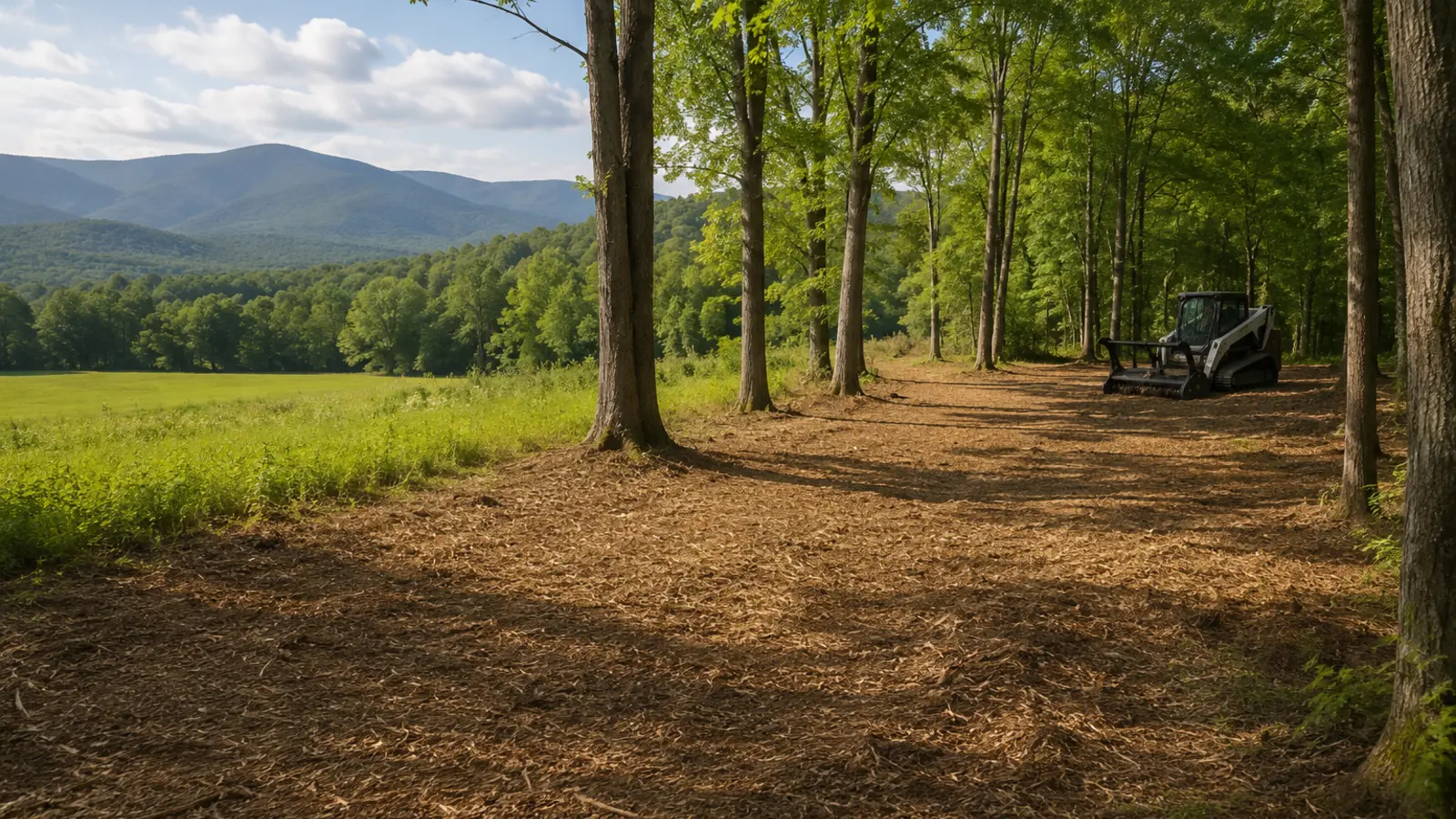
Selective vegetation clearing with retained trees and processed material
Illustrative finish, not a project claim. Actual results follow the marked work limit, vegetation, terrain, soil, access, and written turnover standard.
Field decision

Clear for the next land use

Pasture, orchard, sugarbush, hunting, trail, and farm projects succeed when the clearing width and finish match the next operation.

Coordinate soil, seed, fencing, water, drainage, crop, forestry, or habitat decisions with the appropriate professional after access is restored.

For sugarbush & orchard access clearing, write what stays, what goes, how material is handled, where machines may travel, and what the land should support next.
A four-part project screen
01

Authority

Boundary, easement, utility, road, permit, and owner authorization.

02

Ground

Vegetation, stem size, rock, wetness, debris, grade, and stable access.

03

Method

Mulch, mow, cut, chip, fell, excavate, haul, or use a sequenced mix.

04

Closeout

Finish tolerance, material location, restoration, inspection, and maintenance.

Quote boundaries

Keep adjacent trades out of the gray area.

Define in this scopeSugarbush collection routesOrchard-row and perimeter accessTubing and fence corridorsEquipment and inspection lanes
Price or verify separatelyTechnical tree work and riggingStump or root excavationGrading, drainage, and soilPermits, traffic control, treatment, or restoration
Verified against the primary source

What the rules say about sugarbush & orchard access clearing

The 1 rule below was read from the agency or the statute on the date shown against each one. Nothing here is a determination for your parcel — the authority named is the one whose answer counts.

Clearing enrolled land can trigger the Land Use Change Tax

10% or 20% of FMV — Vermont, Property tax

Land in the Use Value Appraisal ("Current Use") program is taxed on its farm or forest use rather than market value. Developing it triggers a Land Use Change Tax of 10% or 20% of the fair market value of the developed portion, and for eligible forest land that obligation is perpetual.

The definition of "development" is the part that catches clearing projects: it includes construction of a building, road or structure, mining, excavation or landfill — and also cutting timber contrary to the property's forest or conservation management plan or the minimum acceptable standards for forest management. A clearing pass that a plan does not authorise is a tax event, not only a forestry one. More than 16,000 forestland parcels totalling over 2 million acres were enrolled as of 2026, so on Vermont acreage this is a likely question rather than an edge case.

32 V.S.A. Chapter 124 (Use Value Appraisal) · Vermont Department of Taxes / Department of Forests, Parks and Recreation · checked 2026-09-01 · source

Field questions

Know what the machine can—and cannot—solve.

01What does sugarbush & Orchard Access Clearing actually involve?

Narrow tracked machine sized to the lane, with hand work anywhere near tubing or trunk. Selective brush, sapling, lane, fence, and equipment-access clearing for sugarbushes, orchards, and managed tree crops. On a sugarbush & Orchard Access Clearing job the scope should name the marked work limit, the retained vegetation, how material is handled, and the finish standard — those four decide the price far more than the acreage does.

02What is the largest stem sugarbush & Orchard Access Clearing can handle?

3–6 inches in the lanes; work around producing trees is selective and slow by design. That number is the single most useful thing to establish before anyone quotes sugarbush & Orchard Access Clearing, because it decides which machine comes and how many passes the work takes.

03How much ground can sugarbush & Orchard Access Clearing cover in a day?

A planning range of 300–1,200 linear feet of lane per day. Lane production is limited by what has to be protected rather than what has to be cut. Tubing, trellis, irrigation and root zones all mean the machine works carefully at a distance rather than efficiently at a line. This is a production screen, not a quote or a commitment to a schedule.

04What equipment is used for sugarbush & Orchard Access Clearing?

Narrow tracked machine sized to the lane, with hand work anywhere near tubing or trunk. Machine choice on a sugarbush & Orchard Access Clearing job follows the access route and the ground condition as much as the vegetation — a carrier that suits the work is no use if it cannot reach it.

05What does sugarbush & Orchard Access Clearing actually finish?

Collection lanes and equipment routes reopened to a stated width; Competing understory removed from around producing trees; Tubing and infrastructure corridors accessible for inspection and repair; Perimeter and fence corridors cleared. Anything beyond that list on a sugarbush & Orchard Access Clearing project belongs in a separate, separately-priced scope.

06What does sugarbush & Orchard Access Clearing not finish?

Pruning, crop care or tree-health work; Tubing repair, replacement or redesign; Anything touching root zones, which is where careless machine work does invisible damage. Every one of those is a real and common expectation, which is why sugarbush & Orchard Access Clearing proposals should state them as exclusions rather than leaving them to be discovered at turnover.

07When is the best time of year for sugarbush & Orchard Access Clearing?

Late spring through summer, after the sap season and well before the next one, so nothing in production is at risk.

08When should sugarbush & Orchard Access Clearing be avoided?

Anything close to the sap run. Damage to a tubing system found in February is an emergency; found in July it is a repair.

09What happens on the property after sugarbush & Orchard Access Clearing is done?

Lanes reopened and then left grow back into the tubing. An annual or biennial understory pass in the same window keeps the system inspectable.

10What drives the cost of sugarbush & Orchard Access Clearing?

Infrastructure density — tubing everywhere means hand work everywhere. Lane width and length — the two numbers the quote is built on. Retained trees — in a sugarbush essentially everything of value is retained, which makes every pass selective. Slope — sugarbushes are on hillsides because that is where sap flows; that raises the difficulty. Season window — a narrow permissible window costs scheduling flexibility.

11What is the most expensive mistake on a sugarbush & Orchard Access Clearing project?

Running a machine through a sugarbush without a map of the tubing. Mainline is expensive, and the damage is often not discovered until the season it matters.

12Can a landowner do sugarbush & Orchard Access Clearing themselves?

Understory work around tubing with hand tools is exactly the kind of thing a sugarmaker already does well. The lane corridors are where a machine earns its keep.

13What should I measure before asking about sugarbush & Orchard Access Clearing?

Map the tubing — mainlines especially — and mark every retained tree in the work area before quoting. In a sugarbush the exclusions are the scope.

14Is an online range for sugarbush & Orchard Access Clearing a quote?

No. A planning range for sugarbush & Orchard Access Clearing is arithmetic on the numbers you entered — it has not seen the access route, the boundary, the wet ground, the rock, or the largest stem. Production alone spans 300–1,200 linear feet of lane per day before anything else is considered, which is why a site review comes before a price.

15Does the property tax rule in Vermont affect sugarbush & Orchard Access Clearing?

It can, and on a sugarbush & Orchard Access Clearing job it is settled before the machine is scheduled — map the tubing — mainlines especially — and mark every retained tree in the work area before quoting. In a sugarbush the exclusions are the scope. Clearing enrolled land can trigger the Land Use Change Tax (32 V.S.A. Chapter 124 (Use Value Appraisal)). The definition of "development" is the part that catches clearing projects: it includes construction of a building, road or structure, mining, excavation or landfill — and also cutting timber contrary to the property's forest or conservation management plan or the minimum acceptable standards for forest management. A clearing pass that a plan does not authorise is a tax event, not only a forestry one. More than 16,000 forestland parcels totalling over 2 million acres were enrolled as of 2026, so on Vermont acreage this is a likely question rather than an edge case. Checked against Vermont Department of Taxes / Department of Forests, Parks and Recreation on 2026-09-01. Because sugarbush & Orchard Access Clearing typically covers 300–1,200 linear feet of lane per day, a stop part-way through for an approval that was never applied for costs more than the approval would have. The property owner is the applicant; a contractor's estimate is not a determination.

Start with the site

Turn sugarbush & orchard access clearing into a marked scope.

Share the location, acreage, density, slope, access, photos, and intended outcome. We’ll turn the idea into a scope that can be evaluated on the property.

Request a site assessmentOpen the cost calculator →